The best citrus juicer for a restaurant should match your service volume, menu, available counter space, and staff workflow. A compact manual press may suit a cocktail bar, while a commercial electric model can keep pace with breakfast service or fresh-juice orders.
We selected 10 restaurant-ready options spanning manual crank presses, lever-style extractors, compact electric juicers, and higher-throughput machines. Use the guide below to narrow the list by speed, durability, cleanup, juice quality, and operating cost.
Best 10 Citrus Juicer for Restaurant Picks for 2026
Heavy-Duty Manual Pick
Nemco 55850 Easy Citrus Juicer

- Rack-and-pinion design supports consistent pressure
- Durable metal construction for commercial use
- Removable strainer cone and NSF listing
Best For: Restaurants and cafés needing a durable manual citrus press
High-Volume Value
Winco JC-19 Manual Juice Squeezer
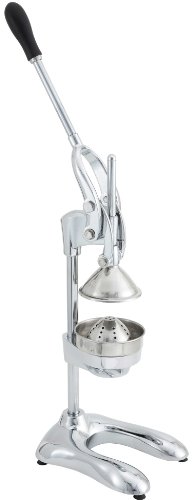
- Commercial-grade stainless steel construction
- Compact design for crowded kitchen layouts
- Handles lemons, limes, oranges, and grapefruit
Best For: Cafés and juice bars needing a compact manual extractor
Powered Press Option
Breville 800CPXL Citrus Press Pro
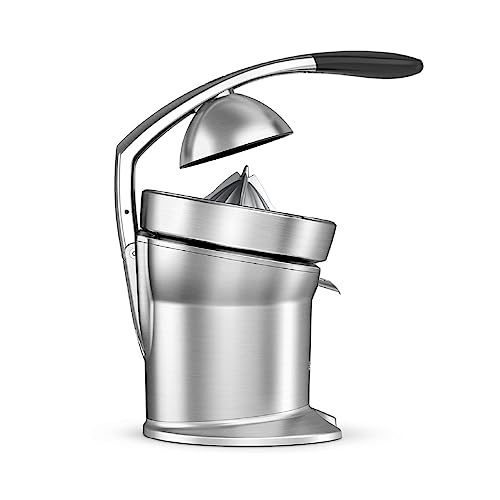
- Power-assisted lever reduces pressing effort
- Acid-resistant die-cast cone and body
- Dishwasher-safe removable juicing parts
Best For: Beverage stations wanting assisted, convenient citrus pressing
Maximum-Force Classic

- Extractor arm delivers up to 2,000 pounds of force
- Acid-resistant finish and stable sure-grip feet
- NSF certified with removable cleaning components
Best For: Commercial kitchens needing powerful, stable manual extraction
Compact Commercial Pick

- Handles up to 120 oranges per hour
- Compact design for space-limited counters
- Universal reamer for assorted citrus
Best For: Small bars, cafes, and restaurants
Manual Heavy-Duty Pick

- Hand-powered with no electricity required
- Cast-iron frame and stainless fruit-contact parts
- Works with citrus and pomegranates
Best For: Bars, cafes, and lower-volume restaurant service
Flexible Electric Pick
YUANHAO Commercial Citrus Juicer
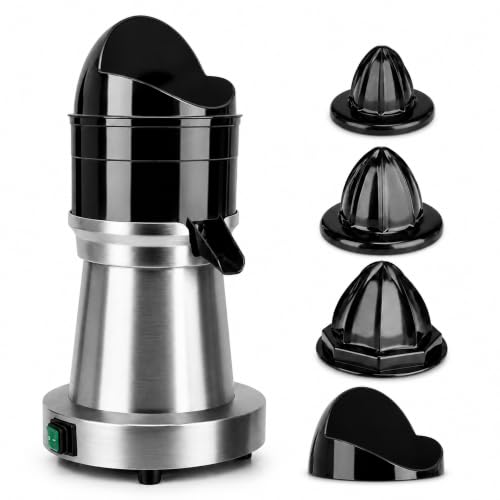
- Three interchangeable reamers
- Stainless-steel body with metal gears
- Splash guard and dishwasher-safe parts
Best For: Busy juice bars, cafes, and restaurants
Best Quiet Commercial Citrus Juicer
Hamilton Beach FreshMark HCJ967R
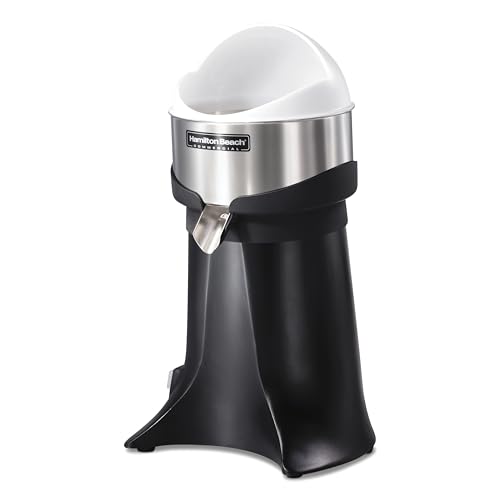
- Quiet 160W brushless induction motor
- Three reamers for multiple citrus sizes
- Tall spout and removable cleaning components
Best For: Quiet restaurant juice service using lemons, limes, oranges, or grapefruit
Best High-Yield Citrus Juicer
VEVOR 100W Slow Masticating Machine

- Processes up to 132–176 lb per hour
- Large basket reduces frequent refilling
- Filters pulp and collects peels separately
Best For: High-volume restaurants and beverage shops
Best Automated Orange Juicer

- Peels, juices, and filters automatically
- Rated for up to 20 oranges per minute
- 304 stainless steel with pull-out filter box
Best For: Fast orange service in restaurants, bars, and beverage counters
Heavy-Duty Manual Pick – Nemco 55850 Easy Citrus Juicer
For a busy restaurant needing a dependable citrus juicer for restaurant service, the Nemco 55850 emphasizes consistent manual extraction, durable construction, and straightforward upkeep. Its rack-and-pinion system and removable strainer cone are practical features for repeated commercial use.
Best For: Restaurants, cafés, juice bars, and operators who want a sturdy manual press with NSF listing.
Pros:
- Rack-and-pinion system is designed to apply smooth, uniform pressure.
- Aluminum, stainless steel, and high-strength steel components support heavy-duty use.
- Removable strainer cone simplifies cleaning and maintenance.
- Ergonomic handle helps reduce effort during repeated pressing.
Cons:
- Manual operation requires physical effort and operator involvement.
- Hand-wash care may take more time than dishwasher-safe alternatives.
- Its tall 19.25-inch profile requires suitable counter clearance.
The Nemco 55850 is a strong fit when durability, sanitation, and repeatable manual performance matter more than automated speed.
High-Volume Value – Winco JC-19 Manual Juice Squeezer
The Winco JC-19 is a practical citrus juicer for restaurant environments that need fresh lemon, lime, orange, or grapefruit juice without a complicated setup. Its commercial-grade stainless steel construction and compact footprint suit busy kitchens, cafés, and juice bars.
Best For: Cafés, juice bars, and restaurant stations handling frequent citrus juicing in limited counter space.
Pros:
- Commercial-grade construction is designed for long-lasting use.
- Compact footprint fits easily into many kitchen layouts.
- Manual design aims to reduce effort while maximizing juice yield.
- Suitable for grapefruit, lemon, orange, and other citrus applications.
Cons:
- Manual pressing can be slower than powered equipment during peak service.
- Hand-wash care adds a cleaning step.
- The supplied notes do not specify an NSF certification.
Choose the JC-19 if you want a compact, stainless steel manual extractor built around straightforward operation and regular citrus service.
Powered Press Option – Breville 800CPXL Citrus Press Pro
For a restaurant seeking a citrus juicer for restaurant beverage service with less manual effort, the Breville 800CPXL combines a power-assisted lever with a corded electric motor. Its acid-resistant cone, drip-stop spout, and dishwasher-safe removable parts make it convenient for made-to-order citrus drinks.
Best For: Beverage stations and smaller commercial settings that value assisted pressing and easier cleanup.
Pros:
- Power-assisted active arm reduces the effort required to press fruit.
- Quadra-Fin cone is designed to extract juice from various citrus sizes.
- Acid-resistant die-cast cone and body support long-term durability.
- Several removable components are dishwasher safe.
Cons:
- Corded electric operation requires access to a 120-volt outlet.
- Its 800 ml capacity may be better suited to made-to-order service than large-batch production.
- The product includes a one-year limited warranty.
The 800CPXL is an appealing choice when assisted pressing, clean workflow, and broad citrus versatility are priorities.
Maximum-Force Classic – Hamilton Beach Commercial 932
The Hamilton Beach Commercial 932 is a purpose-built citrus juicer for restaurant use, delivering manual pressing with an extractor arm rated for up to 2,000 pounds of force. Its acid-resistant finish, sure-grip feet, removable parts, and NSF certification support demanding food-service workflows.
Best For: Commercial kitchens and beverage counters that need high-force manual extraction with stable operation.
Pros:
- Extractor arm provides up to 2,000 pounds of force for high juice output.
- Metal components and enamel finish resist wear from citrus acids.
- Sure Grip feet help prevent tipping during use.
- Removable strainer cone and funnel simplify cleaning and sanitizing.
Cons:
- Manual operation still requires staff effort.
- Hand-wash care is less convenient than dishwasher-safe designs.
- Its 19.5-inch height may require adequate vertical counter space.
The 932 stands out for operators who prioritize pressing force, stability, and food-service durability in a classic manual commercial design.
Compact Commercial Pick – Waring BJ120C Citrus Juicer
If you need a citrus juicer for restaurant service but have limited counter space, the Waring BJ120C offers a compact electric design with capacity for up to 120 oranges per hour. Its universal reamer handles different citrus fruits, while the die-cast base and vibration-dampening feet support stable, quieter operation.
Best For: Small bars, cafes, and restaurants that need electric citrus juicing in a compact footprint.
Pros:
- Compact 7.25-inch by 7.25-inch footprint
- Juices up to 120 oranges per hour
- Universal reamer works with assorted citrus fruits
- Dishwasher-safe care and a one-year limited warranty
Cons:
- One-quart capacity may require frequent emptying during busy service
- Uses a single speed and 150 watts of power
The BJ120C is a practical choice when space and noise matter as much as throughput. Its stated capacity suits moderate commercial demand, though higher-volume operations may want a larger-capacity machine.
Manual Heavy-Duty Pick – CO-Z Commercial Citrus Press
For a citrus juicer for restaurant use without relying on electricity, the CO-Z manual press uses a reinforced cast-iron frame, a long ergonomic lever, and a nonslip suction base. Its 5-inch funnel and stainless-steel strainer make it suitable for oranges, lemons, limes, grapefruit, and pomegranates.
Best For: Cafes, bars, and restaurants that prefer manual pressing for fresh juice or cocktails.
Pros:
- Hand-powered operation requires no electricity
- Cast-iron construction is designed for daily use
- 304 food-grade stainless steel contacts fruit
- Detachable dishwasher-safe parts simplify cleanup
Cons:
- Manual operation is slower and more labor-intensive than an electric juicer
- At 15.3 inches tall and 6 kg, it is relatively substantial for a countertop press
The CO-Z is a sturdy option for lower-volume service, cocktail programs, and locations where portability or electricity-free operation is valuable. Its manual design trades speed for control and simplicity.
Flexible Electric Pick – YUANHAO Commercial Citrus Juicer
The YUANHAO is a flexible citrus juicer for restaurant workflows that need electric operation and interchangeable reamers. Its stainless-steel body, metal gears, splash guard, and pulp filter are designed for repeated citrus use, while the 1400 RPM motor supports fast extraction from oranges, lemons, limes, and grapefruits.
Best For: Busy juice bars, cafes, and restaurants seeking multiple reamer sizes and contained electric juicing.
Pros:
- Includes three reamers for different fruit sizes
- Stainless-steel body and reinforced metal gears
- Splash guard and pulp filter help contain mess
- Removable dishwasher-safe parts support quicker cleanup
Cons:
- Taller 16.93-inch design may need additional vertical clearance
- It has a one-button operation and no stated variable-speed control
The YUANHAO stands out for setup flexibility and cleanup-focused features. The three reamers make it adaptable across citrus sizes, while its relatively tall profile should be checked against available counter space.
Best Quiet Commercial Citrus Juicer – Hamilton Beach FreshMark HCJ967R
For a citrus juicer for restaurant service, the Hamilton Beach FreshMark HCJ967R emphasizes quiet operation, durable construction, and flexible fruit handling. Its 160-watt brushless induction motor, three reinforced reamers, and extra-tall spout make it suitable for preparing lemon, lime, orange, or grapefruit juice directly into different containers.
Best For: Restaurants that need a relatively quiet, versatile electric juicer for glasses, pitchers, and storage containers.
Pros:
- Brushless induction motor is designed for quiet, long-term use.
- Three interchangeable reamers accommodate lemons, limes, oranges, and grapefruit.
- Extra-tall 8.5-inch open spout fits glasses, pitchers, and larger containers.
- Removable bowl components and dishwasher-safe reamers and bowl simplify cleaning.
Cons:
- At 28.1 pounds, it is not especially lightweight to move between work areas.
- The unit uses a sealed on/off push-button rather than automatic fruit feeding.
The HCJ967R is a strong fit when restaurant operators value quiet counter service and adaptable citrus preparation over automated high-volume processing. Its reinforced components and acid-resistant finish are practical choices for regular commercial use.
Best High-Yield Citrus Juicer – VEVOR 100W Slow Masticating Machine
This VEVOR machine is a practical citrus juicer for restaurant operations that need a high stated processing capacity and separated juice and peel collection. Its four rotating shaft assemblies use physical pressing to handle up to 132–176 pounds of citrus per hour, with a stated juice yield above 80%.
Best For: Commercial beverage businesses that need continuous citrus processing with a large loading basket and separate peel collection.
Pros:
- Rated to process 132–176 pounds, or 60–80 kilograms, of citrus per hour.
- Four rotating shaft assemblies and physical pressing are designed for high juice yield.
- Large fruit basket supports refilling without frequent loading.
- Built-in filtration separates juice from pulp while a separate outlet directs peels to a collection bin.
Cons:
- At 51.4 pounds, it requires a stable, dedicated counter location.
- Parts are specified for hand washing only.
- Fruit must be washed, peeled, pitted, and cut to suitable sizes before juicing.
The NS2000E-6 is geared toward throughput rather than compact countertop convenience. Its capacity and peel-management layout may suit restaurants, beverage shops, and fruit stores, provided staff can accommodate its preparation and hand-cleaning requirements.
Best Automated Orange Juicer – VEVOR 120W Commercial Press
For restaurants seeking a citrus juicer for restaurant counter service, this VEVOR model combines automatic peeling, juicing, and filtering in one semi-automatic machine. Its 120-watt motor is rated for up to 20 oranges per minute, while the stainless-steel and PC construction supports commercial use.
Best For: Restaurants, bars, fruit shops, and beverage counters that prioritize fast orange service and integrated peel handling.
Pros:
- Combines peeling, juicing, and filtering in one machine.
- Rated to process up to 20 oranges per minute.
- Large feed chute accommodates citrus and pomegranates measuring 55–80 mm.
- Pull-out filter box and detachable parts support thorough cleaning.
Cons:
- Its 81.4-pound weight and large 25.59-inch width demand substantial counter space.
- Product-care instructions specify hand washing only.
- The feed chute is sized for fruit within a stated 55–80 mm range.
The NS2000E-2 is the most automation-focused option in this group, making it appealing for fast orange service with less manual peeling. Its footprint and heavy weight should be planned for before installation in a busy restaurant workspace.
How We Picked the Best Citrus Juicer for Restaurant
We focused on equipment suited to commercial food-service conditions rather than occasional home use. Our selection includes manual and electric models with different capacities, footprints, extraction styles, and price points. We considered construction materials, stability, removable components, strainer design, motor or leverage performance, expected throughput, and how easily staff can clean the unit between orders.
Because restaurant needs vary widely, the list balances compact presses for bars and cafés with faster machines for buffets, juice counters, and high-volume breakfast operations. Manufacturer-stated capacity and features should be verified against your menu and expected workload before purchase.
Quick Comparison
| Best For | Recommended Type | Main Advantage | Trade-Off |
|---|---|---|---|
| Occasional cocktails and table service | Manual press | Quiet, simple, and inexpensive to operate | Slower for sustained volume |
| Busy bar or café | Commercial lever or crank press | Fast hands-on extraction with no motor | Requires staff effort |
| Breakfast service | Compact electric juicer | Consistent output with less labor | Needs power and routine cleaning |
| Dedicated juice station | High-throughput electric machine | Best speed for repeated orders | Higher cost and larger footprint |
Key Buying Factors for a Citrus Juicer for Restaurant Use
Capacity and Speed
Estimate how many lemons, limes, oranges, or grapefruits you process during your busiest 15-minute period—not just your daily average. Manual presses work well for made-to-order drinks and moderate demand. Electric models are more practical when staff must fill multiple glasses quickly.
Construction and Stability
Look for stainless steel, cast iron, or other corrosion-resistant materials, especially when the juicer will contact acidic fruit juice throughout the day. A heavy base, non-slip feet, or secure mounting helps prevent movement during repetitive use.
Juice Quality and Versatility
Check whether the design accommodates the fruit sizes on your menu and whether the strainer limits seeds and excess pulp. A removable cone or basket can make it easier to switch between citrus types and clean thoroughly.
Cleaning and Food Safety
Prioritize removable, washable juice-contact parts and a design without difficult crevices. Staff should be able to rinse the unit promptly during service and complete a deeper cleaning at closing. Always follow the manufacturer’s sanitation instructions.
Space, Noise, and Operating Cost
Measure the available counter and storage area before ordering. Manual models are quiet and have no electrical operating cost, while electric machines reduce labor but add motor noise, power requirements, and more components to maintain.
Who Should Buy Which Citrus Juicer for Restaurant?
Choose a manual model if your restaurant primarily serves cocktails, garnishes, or occasional fresh juice and values quiet operation and low maintenance. A heavy-duty crank or lever press is a strong middle ground for bars and cafés that need reliable output without dedicating counter space to a motorized appliance.
Choose a compact electric juicer for regular breakfast, brunch, or café orders where consistency and reduced staff effort matter more than absolute throughput. For a dedicated juice bar, hotel buffet, or high-volume restaurant, prioritize an electric machine with a published capacity that comfortably exceeds your peak demand.
Whichever Citrus Juicer for Restaurant service you choose, leave enough room for fruit staging, collection containers, and safe cleaning. Confirm warranty coverage, replacement-part availability, voltage requirements, and the manufacturer’s recommended duty cycle before making the final purchase.