Fresh pasta is easier to make at home when your machine matches your cooking style, available space, and preferred level of hands-on control. The right model can simplify rolling, cutting, mixing, or the entire process.
We compare 10 pasta machines for home bakers, from classic manual makers and KitchenAid attachments to automatic machines that mix, knead, extrude, and shape dough.
Best 10 Pasta Machines for Home Bakers Picks for 2026
Editor's Pick
MARCATO Atlas150 Manual Pasta Maker

- 10 adjustable thickness settings
- Makes lasagna, fettuccine, and tagliolini
- Chrome- and nickel-plated steel construction
Best For: Hands-on pasta makers seeking precise manual control
Best Stand Mixer Attachment

- Fits all household KitchenAid stand mixers
- Includes roller, spaghetti, and fettuccine cutters
- Eight thickness settings with stainless steel parts
Best For: KitchenAid owners wanting powered pasta preparation
Best Value Manual Option

- Seven thickness settings from 0.5 to 3 mm
- Two cutters for spaghetti and fettuccine
- Also suited to dumpling wrappers and lasagna
Best For: Beginners seeking versatile manual pasta making
Best Automatic Model
Philips 7000 Series Pasta Maker

- Automatic 150-watt pasta preparation
- Makes up to eight portions per batch
- Eight discs and dishwasher-safe parts
Best For: Families wanting hands-off, high-capacity pasta making
Best Mixer Attachment

- Eight thickness adjustments
- Mixer-powered dough rolling
- Stainless steel construction
Best For: KitchenAid stand-mixer owners making pasta sheets and filled-dough recipes
Best Manual Starter
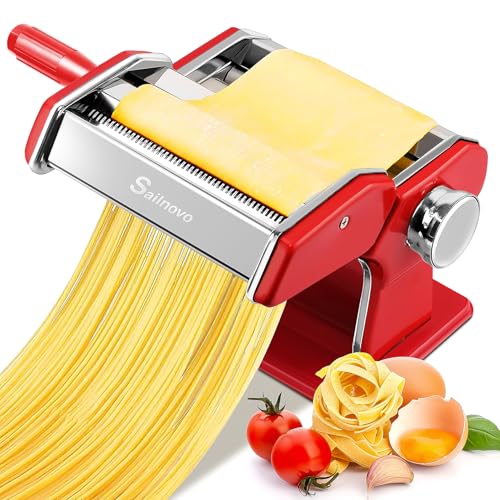
- Nine thickness settings
- Two noodle cutting widths
- Clamp-stabilized hand-crank design
Best For: Beginners and families who prefer hands-on pasta making
Best Automatic Extruder

- Four automatic modes
- 500 g flour capacity
- Eight pasta-shape molds
Best For: Beginners and households wanting automated fresh-noodle production
Best Electric Pick
GVODE 3-in-1 Electric Pasta Maker

- 700W Pmax motor with two speeds and reverse
- Eight thickness settings from 0.4 to 2 mm
- Includes sheet, fettuccine, and spaghetti functions
Best For: Home cooks who want powered pasta rolling and cutting
Best Manual Option
Sur La Table Va Bene Manual Pasta Maker

- Nine adjustable rolling settings
- Cuts spaghetti and fettuccine
- Includes handle and countertop clamp
Best For: Hands-on cooks making sheets, noodles, or dumpling skins
Best High-Output Pick
WICHEMI Automatic Noodle Maker

- Automatic pressing and cutting with one-button control
- Three blades for round and flat noodles
- Stainless steel body with stated 22 lb/h efficiency
Best For: Frequent noodle makers and small-scale high-volume use
Editor's Pick – MARCATO Atlas150 Manual Pasta Maker
MARCATO Atlas150 Manual Pasta Maker Machine-LASAGNA, FETTUCCINE & TAGLIOLINI. Made in Italy
Check Price On AmazonFor home bakers who want hands-on control, the MARCATO Atlas150 is a classic choice among pasta machines for home bakers. Its manual roller offers 10 settings for adjusting dough from 0.8 to 4.8 millimeters, while the included cutters make lasagna, fettuccine, and tagliolini.
Best For: Home cooks who prefer a durable, manually operated machine with broad thickness adjustment and three pasta formats.
Pros:
- 10 thickness settings provide precise dough control.
- Includes cutters for lasagna, fettuccine, and tagliolini.
- Chrome- and nickel-plated steel construction with a 2.6-kilogram weight.
Cons:
- Manual operation requires turning the crank while feeding dough.
- It does not include an electric motor.
The Atlas150 suits bakers who enjoy the traditional pasta-making process and want a wide range of sheet thicknesses. Its focused set of functions makes it a practical option for regular homemade pasta.
Best Stand Mixer Attachment – KitchenAid 3-Piece Pasta Set
If you already own a household KitchenAid stand mixer, this three-piece set is a convenient addition to your lineup of pasta machines for home bakers. The mixer powers the roller and cutters, while eight thickness settings help produce consistent six-inch sheets.
Best For: KitchenAid owners who want powered rolling plus spaghetti and fettuccine cutting in one set.
Pros:
- Fits all household KitchenAid stand mixers.
- Includes a roller, spaghetti cutter, and fettuccine cutter.
- Eight thickness settings and stainless steel rollers support consistent results.
- Cleaning brush is included.
Cons:
- Requires a compatible KitchenAid stand mixer, sold separately.
- Hand-wipe cleaning is required.
This set is a strong fit for bakers who want to avoid hand-cranking but already have the required KitchenAid mixer. It focuses on the most commonly made sheet and noodle shapes without adding unnecessary attachments.
Best Value Manual Option – Nuvantee 3-in-1 Pasta Maker
The Nuvantee offers flexible manual pasta making at a practical range of settings, making it a useful option among pasta machines for home bakers. Its seven-position roller adjusts from 0.5 to 3 millimeters, and two cutters handle 2-millimeter spaghetti or 6-millimeter fettuccine.
Best For: Beginners and families looking for a manual machine for pasta, lasagna sheets, and dumpling wrappers.
Pros:
- Seven adjustable thickness settings cover 0.5 to 3 millimeters.
- Two cutter widths create spaghetti or fettuccine-style noodles.
- Stainless steel and aluminum construction.
- Manual design is accessible for hands-on kitchen use.
Cons:
- Manual operation requires continuous hand cranking.
- The supplied blade material is aluminum rather than stainless steel.
With its two cutter widths and broad thickness range, the Nuvantee is versatile for everyday experimentation. It is especially appealing if you want one manual tool for both pasta and dumpling-wrapper preparation.
Best Automatic Model – Philips 7000 Series Pasta Maker
For bakers who prioritize convenience, the Philips 7000 Series brings automatic mixing and shaping to the category of pasta machines for home bakers. Its 150-watt ProExtrude system can prepare up to eight portions, with eight shaping discs and guidance available through the HomeID app.
Best For: Families and entertainers who want hands-off pasta preparation and a larger batch capacity.
Pros:
- Automatic operation with 150-watt ProExtrude technology.
- Prepares up to eight portions in one batch.
- Includes eight discs for shaping different pasta types.
- Dishwasher-safe, non-stick parts simplify cleanup.
Cons:
- At 20 pounds, it is substantially heavier than the manual models listed.
- Its automatic design is larger and less compact for storage.
- The listed thickness range is limited to 1 to 1.5 millimeters.
The Philips is the most convenient choice here for larger households and frequent batch cooking. Choose it when speed, automatic mixing, and cleanup matter more than manually rolling a broad range of sheet thicknesses.
Best Mixer Attachment – KitchenAid Pasta Roller
For home bakers who already own a compatible KitchenAid stand mixer, this pasta roller attachment offers a hands-off way to make fresh pasta dough sheets. Its eight thickness settings can handle recipes ranging from lasagna and ravioli to noodles, dumplings, and wonton wrappers.
Best For: KitchenAid stand-mixer owners who want powered dough rolling without buying a separate manual pasta machine.
Pros:
- Eight adjustable thickness settings, ranging from 0.8 to 8 mm.
- Stainless steel construction and internal gears are designed for durable, efficient rolling.
- Includes a cleaning brush and installs on a compatible stand mixer.
- Suitable for pasta sheets, ravioli, tortellini, dumplings, empanadas, and tacos.
Cons:
- Requires a compatible KitchenAid stand mixer; the mixer is not included.
- Not dishwasher safe and should not be soaked for extended periods.
- It is not manufactured by KitchenAid or Cuisinart.
This is a practical choice for frequent pasta makers who value mixer-powered convenience. If you do not already have a compatible stand mixer, a standalone machine may be more versatile.
Best Manual Starter – Sailnovo 3-in-1 Pasta Maker
For home bakers looking for traditional pasta machines for home bakers, the Sailnovo 3-in-1 combines hand-cranked rolling with built-in cutters. It offers nine thickness settings and two noodle widths for making spaghetti, fettuccine, lasagna sheets, dumplings, and other dough-based dishes.
Best For: Beginners and families who want an affordable, hands-on pasta-making experience with adjustable thickness and cutting options.
Pros:
- Nine thickness settings cover dough from 0.3 to 3 mm.
- Two cutting widths produce approximately 2 mm or 6.25 mm noodles.
- Food-grade materials and rust-resistant aluminum-alloy rollers are designed for direct food contact.
- Includes a clamp to help stabilize the machine during manual operation.
Cons:
- Manual hand-crank operation requires more effort than an electric machine or mixer attachment.
- Cleaning is recommended with a dry brush or cloth rather than water immersion.
- The specifications list one unit setting despite the product description detailing nine thickness settings and two widths.
This model suits shoppers who enjoy controlling the pace of pasta preparation and involving family members in the process. Its clamp and straightforward design make it approachable, while the manual operation may be less convenient for large batches.
Best Automatic Extruder – VEVOR Electric Pasta Maker
Home bakers who want to minimize manual mixing and rolling may prefer this 150W electric pasta maker. It uses four automatic modes, supports up to 500 g of flour, and includes eight discs for producing different noodle shapes in about 14 minutes for roughly four people.
Best For: Busy households and beginners who want automated mixing, kneading, and extrusion for fresh noodles.
Pros:
- Four automatic modes simplify fresh-noodle preparation.
- 500 g flour capacity can make enough noodles for approximately four people.
- Eight included molds provide multiple pasta-shape options.
- Includes measuring cups, a spatula, cleaning brush, and dishwasher-safe parts.
Cons:
- At 11 pounds, it is heavier than a compact manual pasta maker.
- Accurate flour-to-water ratios are important to prevent sticking or failed extrusion.
- Its electric extrusion format is less suited to shoppers specifically seeking rolled pasta sheets.
This is the most automated option in the group and can be a strong fit when convenience and batch size matter. Following the included ratio guidance is essential, but the automatic modes and broad selection of discs reduce hands-on work.
Best Electric Pick – GVODE 3-in-1 Electric Pasta Maker
For home bakers seeking pasta machines for home bakers that reduce manual effort, the GVODE combines powered rolling and cutting with a stainless steel housing. Its eight thickness settings, two speeds, and reverse function support a range of fresh pasta styles without requiring a stand mixer.
Best For: Home cooks and families who want electric rolling, fettuccine, and spaghetti cutting in one countertop machine.
Pros:
- Stainless steel housing and metal drive gears are designed for durability and easy cleanup.
- Eight settings cover sheets from approximately 0.4 to 2 mm, with two speeds and reverse.
- Includes a sheet roller, fettuccine cutter, spaghetti cutter, brush, and manual.
Cons:
- Requires 15-minute operating batches followed by a five-minute cool-down for motor longevity.
- It is a roller-and-cutter machine, not a pasta extruder.
The GVODE is a practical choice when convenience matters more than hands-on cranking. Follow the recommended cooling rhythm and progressively thin the dough before cutting for cleaner results.
Best Manual Option – Sur La Table Va Bene Manual Pasta Maker
Among pasta machines for home bakers, this Sur La Table model suits cooks who prefer direct control over the rolling process. The stainless steel manual machine uses a hand crank, detachable cutter, and countertop clamp to make sheets, spaghetti, fettuccine, and dumpling skins.
Best For: Hands-on cooks who enjoy traditional pasta making and want adjustable dough thickness for noodles, lasagna, and filled pasta.
Pros:
- Nine adjustable settings provide control over dough thickness.
- Detachable shaper cuts both fettuccine and spaghetti strips.
- Removable handle and included clamp help support stable countertop operation.
Cons:
- Manual cranking requires more effort than an electric machine.
- Care instructions specify hand washing only.
This is a straightforward option for bakers who value the process as much as the finished pasta. Its clamp and multiple settings make it flexible for both flat sheets and cut noodles.
Best High-Output Pick – WICHEMI Automatic Noodle Maker
For home bakers comparing pasta machines for home bakers with higher output, the WICHEMI offers automatic pressing and cutting in a compact stainless steel body. Its one-button operation and three blade options produce round or flat noodles, while the roller can also prepare dumpling and wonton skins.
Best For: Households or small food businesses that need quick, automatic noodle production and several noodle shapes.
Pros:
- Automatic three-in-one operation presses dough and cuts noodles.
- Three blade options make 2.5 mm round, 4 mm flat, and 9 mm flat noodles.
- 304 stainless steel construction and a stated efficiency of up to 22 lb/h.
Cons:
- Its listed 17.6-pound weight makes it less portable than a lightweight manual maker.
- The available thickness range is listed as approximately 1.5 to 4 mm, offering less fine adjustment than some roller-style machines.
The WICHEMI emphasizes speed and simplicity over traditional hand-crank control. It is especially appealing if you regularly make multiple noodle styles or want a machine that can handle larger batches.
How We Picked the Best Pasta Machines for Home Bakers
We evaluated these machines by looking at their pasta-making method, included functions, adjustment options, capacity, compatibility, and overall practicality for home use. The lineup includes manual roller-and-cutter machines, KitchenAid attachments, and automatic models with built-in mixing and extrusion.
We also considered how easily each type fits different routines. Manual machines offer direct control and a traditional workflow, while electric and automatic models can reduce physical effort and preparation time. Because durability and cleanup matter as much as output, buyers should also check construction materials, removable parts, storage needs, and the availability of replacement accessories.
Quick Comparison
| Machine type | Best for | Main advantage | Potential trade-off |
|---|---|---|---|
| Manual roller and cutter | Traditional pasta makers | Control, simplicity, and usually lower cost | Requires hand cranking and separate dough preparation |
| Stand-mixer attachment | KitchenAid owners | Hands-free rolling and convenient storage | Requires a compatible stand mixer |
| Automatic pasta maker | Fast, repeatable batches | Mixes, kneads, and shapes with less manual work | Typically larger, heavier, and more complex to clean |
Key Buying Factors for Pasta Machines for Home Bakers
Manual Control Versus Automation
Choose a manual machine if you enjoy shaping dough and want control over sheet thickness. An automatic machine is more suitable if convenience is the priority or if kneading dough by hand is difficult. Some electric roller attachments provide a useful middle ground by automating rolling while preserving a familiar process.
Roller Settings and Cutter Options
More thickness settings give you greater control for delicate sheets, lasagna, ravioli, and thicker noodles. Check which cutters are included rather than assuming every machine makes the same shapes. Spaghetti, fettuccine, tagliolini, and lasagna are common options, but automatic models may offer additional discs or extrusion shapes.
Capacity, Counter Space, and Cleanup
Consider how much pasta you normally make at once. Larger automatic machines can handle bigger batches, but they need more counter and storage space. Removable parts and accessible dough channels make cleanup easier; always follow the manufacturer’s guidance, especially when dry-brushing is recommended instead of washing components.
Compatibility and Durability
For a stand-mixer attachment, verify the exact mixer brand and connection style before buying. Stainless-steel rollers and cutters are generally desirable for frequent use, while sturdy clamps and stable bases help manual machines operate safely.
Who Should Buy Which Pasta Machines for Home Bakers?
Buy a manual roller-and-cutter machine if you want an affordable, compact introduction to fresh pasta and do not mind turning a crank. Choose a KitchenAid attachment if you already own a compatible mixer and want powered rolling without adding a separate motor. Select an automatic pasta maker if you value convenience, consistent portions, and one-machine preparation. For frequent cooks, prioritize durable construction, easy cleaning, replacement parts, and the pasta shapes your household actually eats.