Choosing among grain mills with adjustable grind settings is easier when you match the mill’s adjustment range, power, capacity, and cleaning demands to the ingredients you actually use. The models in this roundup include compact electric grinders, heavy-duty machines, manual mills, and a stand-mixer attachment.
Whether you want fine baking flour, coarse cornmeal, cracked grains, or occasional spice grinding, the right mill should offer dependable control without creating unnecessary work. Use the comparison and buying advice below to narrow the options by performance, convenience, and budget.
Best 10 Grain Mills with Adjustable Grind Settings Picks for 2026
Best Adjustable Electric Mill
500W 9-Setting Grain and Spice Grinder

- Nine adjustable grind levels
- Detachable 800 mL stainless steel cup
- Preset cycles for dry ingredients
Best For: Home cooks grinding dry grains, coffee, spices, and nuts
Best Manual Grain Mill
Victoria Cast Iron Hand-Crank Mill

- Adjustable screw controls coarseness
- Heavy-duty cast iron construction
- Clamps to tables 1/2–2 inches thick
Best For: Manual milling of grains, corn, seeds, and spices
Best High-Capacity Mill
3600W 2500g Adjustable Flour Grinder

- 30-300 mesh adjustable fineness
- 2500 g stainless steel jar
- Overload protection and lock lid
Best For: Large batches of dry grains, flour, coffee, and spices
Best Wet-and-Dry Mill
VEVOR 3000W Adjustable Commercial Grinder

- Wet and dry grinding capability
- Adjustable thickness control
- Heavy-duty 3000W motor and cast iron body
Best For: Wet foods, dry grains, flour, starch, and feed processing
Best Mixer Attachment
12-Level KitchenAid Grain Mill

- 12 adjustable levels from coarse to fine
- All-metal design for dry grains
- Uses a compatible KitchenAid mixer motor
Best For: KitchenAid owners making fresh flour at home
Best High-Capacity Electric

- 2,100W motor with 1.8-pound capacity
- Timed controls and 30-to-300-mesh range
- Stainless-steel blades for dry ingredients
Best For: Larger batches of dry grains and spices
Best Versatile Fine-Grind Range

- 50-to-300-mesh adjustable fineness
- 1,800W motor with five-minute timer
- Includes spare parts and safety features
Best For: Multi-purpose dry-food grinding in smaller batches
Best Manual Option

- Three coarse-to-fine settings
- No electricity or motor required
- Large 0.53-gallon hopper
Best For: Electricity-free home milling and versatile ingredient prep
Best High-Speed Electric
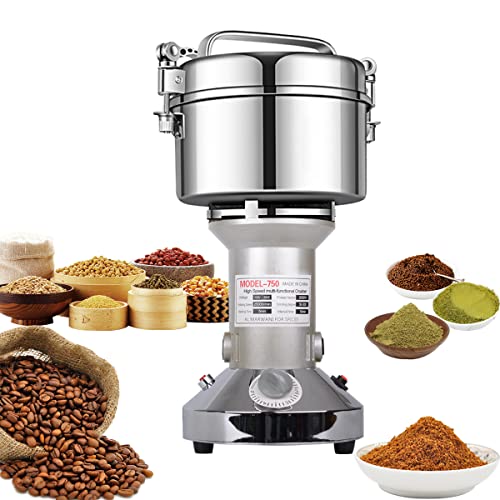
- 2,000-watt, 25,000-RPM motor
- 50–300 mesh fineness range
- 750-gram dry-ingredient capacity
Best For: Fast batch grinding of dry grains and spices
Best Heavy-Duty Capacity
3000W Adjustable Grain Grinder

- Coarse-to-fine knob adjustment
- Claimed 200-pound-per-hour capacity
- Durable galvanized cast iron housing
Best For: High-volume dry-grain and livestock-feed milling
Best Adjustable Electric Mill – 500W 9-Setting Grain and Spice Grinder
If you want grain mills with adjustable grind settings for everyday kitchen use, this 500W electric model offers nine texture levels, preset grinding times, and an 800 mL detachable stainless steel cup. It is designed for dry grains as well as coffee, spices, herbs, nuts, and other ingredients.
Best For: Home cooks who want a versatile, easy-to-clean grinder for small-to-moderate batches of dry ingredients.
Pros:
- Nine adjustable settings provide fine, medium, or coarse textures.
- Detachable stainless steel cup makes emptying and cleaning easier.
- 500W motor and 800 mL capacity suit grains, coffee, spices, and nuts.
- Preset 30- or 60-second cycles simplify routine grinding.
Cons:
- Designed for dry ingredients, so it is not a wet mill.
- Preset cycles may require a second run when a finer grind is needed.
This is a practical choice when convenience and texture control matter more than traditional milling. The viewing lid also lets you stop the process when the grind looks right.
Best Manual Grain Mill – Victoria Cast Iron Hand-Crank Mill
For shoppers comparing grain mills with adjustable grind settings and preferring manual operation, this Victoria mill uses an adjustable screw to control coarseness and fineness. Its cast iron body, hand crank, and 1200 g low hopper make it suited to hands-on milling without electricity.
Best For: Users who want a durable manual mill for grains, corn, seeds, spices, and other food-preparation tasks.
Pros:
- Adjustable screw changes the grind from coarser to finer textures.
- Heavy-duty cast iron construction is built for repeated manual use.
- Clamps to tables 1/2 to 2 inches thick and includes a non-slip protector.
- Can handle grains, coffee, cheese, vegetables, seeds, nuts, and spices.
Cons:
- It cannot produce a superfine texture.
- It will not grind whole wheat into a fine powder.
- Manual cranking requires more effort than an electric mill.
This mill is a good fit for traditional, electricity-free grinding, especially for corn and coarser preparations. Buyers specifically seeking fine flour should choose a different design.
Best High-Capacity Mill – 3600W 2500g Adjustable Flour Grinder
Among grain mills with adjustable grind settings, this high-capacity electric model stands out for its 30-300 mesh range, 3600W motor, and 2500 g stainless steel jar. It is intended for dry grains, flour making, coffee, beans, and spices in home or light commercial settings.
Best For: Large-batch users, home bakers, coffee shops, restaurants, and kitchens that need very fine dry grinding.
Pros:
- 30-300 mesh adjustment supports a broad range of flour fineness.
- 2500 g capacity is suited to larger batches.
- 3600W copper motor and triple-blade design target fast, fine grinding.
- Includes overload protection and a secure buckle-lock lid.
Cons:
- Requires 3-minute operating intervals followed by 5-10 minute cool-downs.
- Ingredients must be completely dry and the jar should not be filled beyond two-thirds.
- Maintenance requires wiping with a dry cloth rather than washing with water.
This is the strongest option here for high-volume dry milling and adjustable flour fineness. Its operating limits and dry-only requirements make it less convenient for casual, mixed-ingredient use.
Best Wet-and-Dry Mill – VEVOR 3000W Adjustable Commercial Grinder
For buyers seeking grain mills with adjustable grind settings that can handle more than dry ingredients, this VEVOR model offers adjustable thickness plus separate cast iron and sand milling discs. Its 3000W motor is designed for dry grains, soaked soybeans and rice, flour, starch, and feed.
Best For: Users who need a heavy-duty mill for both dry powders and wet grinding applications such as soy milk or rice cakes.
Pros:
- Supports both wet and dry grinding with two included milling discs.
- Adjustable thickness suits corn, wheat, cereal, coffee, spices, and nuts.
- 3000W motor is designed for continuous, high-capacity grinding.
- Stainless steel funnel provides a steady feeding process.
Cons:
- Large industrial-style dimensions require substantial storage space.
- Its heavy-duty design may be more than needed for occasional home use.
- The supplied notes do not specify a hopper capacity or precise grind range.
This is the most versatile choice for shoppers who need wet-and-dry capability rather than a dry-only kitchen grinder. Its cast iron construction and industrial footprint favor demanding food-processing tasks.
Best Mixer Attachment – 12-Level KitchenAid Grain Mill
If you already own a compatible KitchenAid stand mixer, this attachment offers a space-saving way to explore grain mills with adjustable grind settings. Its 12-position dial moves from coarse cracking to fine flour, and the metal construction is designed for grinding dry, non-oily grains such as wheat, corn, oats, buckwheat, and millet.
Best For: KitchenAid owners who want adjustable, small-batch fresh flour grinding without adding a separate countertop motor.
Pros:
- 12 grind levels let you choose a coarse-to-fine consistency.
- All-metal construction is designed for durable use with hard grains.
- Works with KitchenAid stand mixer motors and includes a cleaning brush.
Cons:
- Requires a KitchenAid stand mixer; the mixer is not included.
- Limited to dry, non-oily grains and should not be placed in a dishwasher.
- The supplied guidance recommends cooling the mixer for 45 minutes after grinding 10 cups.
This is the most integrated option of the three, but its usefulness depends on already having a KitchenAid mixer. The multi-step grinding guidance also makes it better suited to patient home users than high-volume milling.
Best High-Capacity Electric – VEVOR 1.8-Pound Grain Mill
For shoppers comparing grain mills with adjustable grind settings and faster electric operation, the VEVOR combines a 2,100-watt motor with a 1.8-pound capacity. Its timed controls and stated 30-to-300-mesh range support everything from less-fine grinding to fine powders, although it is intended for dry ingredients only.
Best For: Home kitchens, small labs, and users who want a larger-capacity machine for dry grains, spices, coffee, and other non-wet ingredients.
Pros:
- Large 1.8-pound capacity and 2,100 watts support efficient batch grinding.
- Offers 5-, 15-, and 30-second timers plus a stated 30-to-300-mesh fineness range.
- Triple stainless-steel blades and a 270-degree swinging design help promote even grinding.
Cons:
- Not suitable for wet, oily, or sticky materials.
- Continuous operation is limited to five minutes followed by a recommended rest period.
- At 9.3 pounds, it is less portable than a small countertop grinder.
The VEVOR stands out when capacity and speed matter more than compactness. Its controls are straightforward, but users should follow the duty-cycle guidance and prepare harder ingredients as directed.
Best Versatile Fine-Grind Range – 550g Electric Grain Mill
This 550-gram electric grinder is a versatile choice for shoppers seeking grain mills with adjustable grind settings across a broad fineness range. Its 1,800-watt motor, 50-to-300-mesh adjustment, and five-minute timer are aimed at dry grains, spices, herbs, coffee, and other non-oily ingredients.
Best For: Users who want one compact electric machine for fresh flour, fine spice blends, coffee, and other dry-food grinding tasks.
Pros:
- Adjustable 50-to-300-mesh range covers coarse through ultra-fine textures.
- 1,800-watt motor and triple-layer stainless-steel blades handle a broad range of dry ingredients.
- Includes safety lid-lock and overload protection, plus spare blades, carbon brushes, and cleaning tools.
- Includes a five-minute timer for hands-free operation.
Cons:
- 550-gram capacity is smaller than the VEVOR’s 1.8-pound capacity.
- Designed for dry, non-oily foods rather than wet or sticky ingredients.
- The supplied dimensions make it a relatively tall countertop appliance.
This model offers the broadest stated fineness range in the group and the most extensive accessory package. It is a strong fit for varied dry-food tasks, provided its smaller chamber matches your batch size.
Best Manual Option – VEVOR Flywheel Grain Mill
For shoppers comparing grain mills with adjustable grind settings, this VEVOR manual model offers three choices—coarse, medium, and fine—without requiring electricity. Its hand-crank design is suited to home users who value control, quiet operation, and preserving flavor by avoiding heat buildup.
Best For: Home milling, baking, brewing, and processing grains, spices, coffee beans, and nuts without electricity.
Pros:
- Three adjustable settings accommodate coarse, medium, and fine textures.
- Manual operation helps avoid heat buildup and preserves natural aroma and nutrients.
- Wide base improves stability, while the 0.53-gallon hopper supports larger batches.
- Powder-coated carbon steel construction resists rust and wear.
Cons:
- Hand-cranking requires more effort than an electric grinder.
- It is heavy at 32.2 pounds and has a sizable footprint.
- The flywheel can support belt or motor drive, but a motor is not included.
This is a practical choice when adjustable control and electricity-free operation matter more than speed. Its stable construction and versatile ingredient range make it a flexible household mill.
Best High-Speed Electric – 750g Stainless Steel Grinder
This compact electric grinder is a fast option among grain mills with adjustable grind settings, producing textures from 50 to 300 mesh in under a minute according to the supplied specifications. It is designed for dry ingredients and uses a 2,000-watt motor with a 750-gram capacity.
Best For: Quickly pulverizing dry grains, coffee, spices, herbs, rice, and similar ingredients in home or small professional settings.
Pros:
- High-speed motor and three-blade design support rapid grinding.
- Stainless steel construction is sturdy and durable.
- Handles a broad range of dry grains, spices, herbs, nuts, and coffee beans.
- Overload protection automatically shuts off the unit for added safety.
Cons:
- It cannot grind wet, moist, or oily materials.
- Operation should be limited to three minutes followed by a five- to ten-minute rest.
- The motor housing should not be rinsed directly, making cleanup more hands-on.
This model favors speed and fine pulverizing over continuous operation. Buyers should be comfortable measuring dry ingredients, respecting the fill limit, and following the required rest intervals.
Best Heavy-Duty Capacity – 3000W Adjustable Grain Grinder
For larger workloads, this 3,000-watt electric mill stands out among grain mills with adjustable grind settings. Its control knob lets users move from coarse grains to fine powder, while the supplied specifications claim processing capacity of up to 200 pounds of grain per hour.
Best For: Small farms, livestock-feed preparation, home flour milling, brewing, and high-volume dry-grain processing.
Pros:
- Adjustable grind control handles coarse feed through fine powder.
- Powerful 3,000-watt pure copper motor is designed for high-throughput work.
- Galvanized cast iron housing is described as corrosion-resistant and durable.
- Suitable for dry corn, wheat, soybeans, rice, barley, and some herbs.
Cons:
- At 47 pounds and 30.7 inches tall, it requires substantial floor space.
- Its industrial design may be more machine than casual kitchen users need.
- The supplied notes specify dry ingredients, so it is not a general wet-food grinder.
This is the strongest fit for buyers prioritizing throughput and a broad coarse-to-fine range. Its weight, height, and industrial construction make a dedicated work area advisable.
How We Picked These Grain Mills with Adjustable Grind Settings
We selected these 10 models to cover the main ways home cooks and small-scale users mill dry ingredients. The lineup includes manual cast-iron and carbon-steel mills, compact electric grinders, high-capacity pulverizers, commercial-style machines, and a KitchenAid-compatible attachment. We compared the advertised adjustment range, motor power or manual leverage, hopper and cup capacity, construction, intended ingredients, and cleaning practicality.
Because product specifications vary considerably, treat claims such as wattage, mesh range, speed, and capacity as indicators rather than guarantees of real-world output. Fine flour may require more than one pass, and many high-speed grinders are better suited to dry ingredients than oily, wet, or sticky foods.
Quick Comparison
- Best for convenience: Electric models with preset timers or detachable stainless-steel cups.
- Best for hands-on milling: Manual cast-iron or carbon-steel mills with adjustable fineness.
- Best for stand-mixer owners: The 12-level KitchenAid-compatible attachment.
- Best for larger batches: High-capacity electric machines with substantial hoppers or grinding chambers.
- Best for occasional use: Compact 500W to 550g electric grinders that take up less counter space.
Key Buying Factors for Grain Mills with Adjustable Grind Settings
Adjustment Range and Texture Control
Look for clearly defined settings or a usable fineness mechanism. A narrow range may work for flour and meal, while mesh-based or multi-level controls can offer more flexibility for coarse grains, cereal, and spice powders. Confirm that the adjustment applies to the finished texture rather than only the hopper opening.
Capacity and Batch Size
Small cups are convenient for quick batches but may require repeated loads. Larger chambers suit bread baking, animal feed, or frequent milling, although they usually increase weight, noise, and storage demands.
Power, Speed, and Ingredient Compatibility
Higher wattage can help with demanding dry grains, but it does not alone determine flour quality. Check whether the manufacturer permits wheat, corn, oats, herbs, spices, or other ingredients you plan to process. Avoid assuming a dry-grain grinder can handle oily seeds or moist foods.
Construction, Safety, and Cleanup
Stainless-steel chambers are generally durable and easy to wipe clean; cast-iron manual mills offer longevity but may need drying and occasional seasoning. Prioritize secure lids, stable bases, overload protection, cooling guidance, and removable parts where available.
Who Should Buy Which Grain Mills with Adjustable Grind Settings?
Choose a manual mill if you value durability, quiet operation, and independence from electricity and do not mind slower output. Choose a compact electric grinder for occasional flour, herbs, spices, or small servings. A high-powered commercial-style machine makes more sense for frequent large batches, provided you have room for it and can tolerate more noise.
If you already own a compatible KitchenAid stand mixer, the attachment can provide adjustable milling without adding another motorized appliance. For the best overall fit, prioritize the adjustment system and supported ingredients first, then compare capacity, cleanup, and available counter space.