The best energy-efficient portable refrigerators make it easier to keep food and drinks cold without taking up the space or using the power of a full-size refrigerator. This roundup includes compressor coolers for vehicles and camping, plus compact mini fridges for bedrooms, offices, and dorms.
We compare capacity, temperature range, power options, energy efficiency, noise, and portability so you can choose a refrigerator that fits your space, routine, and budget.
Best 10 Energy Efficient Portable Refrigerators Picks for 2026
Compact Dual-Voltage Pick
Frigidaire 21-Qt Portable Fridge Freezer

- 21-quart compressor fridge/freezer
- 12/24V DC and 100–240V AC operation
- R600a refrigerant and 45 dB operation
Best For: Short trips, vehicles, camping, and compact spaces
Smart Travel Value

- 45W compressor with fast cooling
- Bluetooth app control and ECO/MAX modes
- Three-level battery protection
Best For: Connected, battery-conscious car and camping use
Efficient Indoor Mini Fridge
Midea 1.6-Cu.-Ft. Refrigerator

- ENERGY STAR certified
- Below-42 dB operation
- Reversible door and removable shelf
Best For: Dorms, bedrooms, offices, and compact indoor spaces
Large-Capacity Road-Trip Choice

- 37-quart single-zone capacity
- ECO/MAX modes with fast compressor cooling
- Wheels, pull handle, and battery protection
Best For: Family travel, RVs, camping, and longer outings
Best Energy Star Mini Fridge
BLACK+DECKER 1.7 Cu. Ft. Refrigerator

- ENERGY STAR certified compressor design
- Includes a 0.33-cubic-foot freezer
- Reversible door and adjustable storage
Best For: Dorms, offices, bedrooms, and RVs needing everyday refrigeration
Best USB-Powered Personal Cooler
Cooluli Classic 4L Mini Fridge

- Compact 4-liter, approximately 4-pound design
- Supports AC, DC, and USB power
- Cools and warms personal items
Best For: Skincare, medications, snacks, and drinks at desks or in cars
Best Compact Choice
Upstreman 3.2 Cu.Ft. Mini Fridge

- Energy Star certified and rated at 206 kWh annually
- Quiet 38 dB compressor operation
- Reversible door and adjustable glass shelves
Best For: Dorms, bedrooms, offices, and apartments
Best Low-Use Option
3.2 Cu. Ft. Mini Fridge with Freezer

- Reported use of about 0.55 kWh per day
- Quiet compressor rated below 37 dB
- Six thermostat settings and one-touch defrosting
Best For: Quiet rooms and users watching daily electricity use
Best Small-Footprint Pick
DEMULLER 2.4 Cu.Ft. Refrigerator
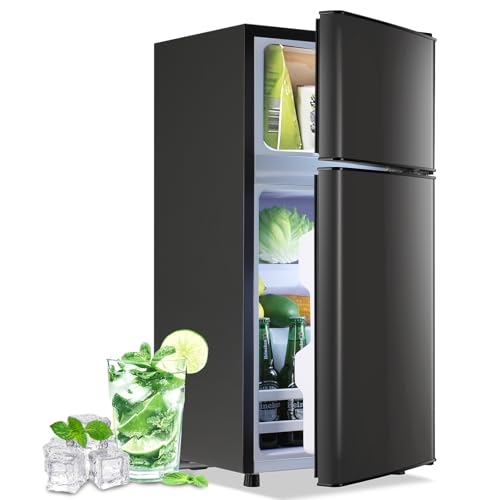
- Lists 146 kWh annual energy consumption
- Separate 0.8-cu.-ft. top freezer
- Compact 15 x 14.6 x 30.8-inch footprint
Best For: Small rooms needing a separate freezer
Compact Dual-Voltage Pick – Frigidaire 21-Qt Portable Fridge Freezer
For shoppers seeking energy efficient portable refrigerators, this compact Frigidaire offers flexible AC/DC operation, compressor cooling, and a convertible temperature range from -4°F to 68°F. Its 21-quart capacity suits short trips, vehicles, and small living spaces.
Best For: Car travel, camping, road trips, and compact indoor storage.
Pros:
- Runs on 12/24V DC or 100–240V AC, with a cigarette-lighter cable included.
- Adjusts from refrigerator temperatures to freezer temperatures.
- Uses R600a refrigerant and lists 100 kWh annual energy consumption.
- Operates at a relatively quiet 45 dB and includes an interior light.
Cons:
- Its 21-quart capacity is better suited to essentials than large provisions.
- Manual defrosting requires occasional maintenance.
- At 24 pounds, it is less convenient to carry than smaller coolers.
This is a practical choice when you need one portable appliance that can chill or freeze and work both in a vehicle and at home. The modest capacity and manual defrost design are the main trade-offs.
Smart Travel Value – EUHOMY 23-Qt 12V Refrigerator
This EUHOMY is a strong option among energy efficient portable refrigerators for travelers who want app control and low-power operation. Its compressor cools quickly, while ECO/MAX modes and three-level battery protection help tailor performance for road use.
Best For: Drivers and campers who want remote control, fast cooling, and battery-conscious operation.
Pros:
- Consumes 45W and cools from 77°F to 32°F in about 15 minutes.
- Bluetooth app control allows temperature management from a distance.
- Supports 12/24V DC and 100–240V AC power.
- Includes three-level battery protection and anti-shock operation for uneven roads.
Cons:
- Its annual energy consumption is listed at 101.53 kWh.
- The included warranty is listed as one year, despite two years of technical support.
- At 40 dB, it is quiet but not silent.
The 23-quart size balances portability and storage, while app control adds convenience. It is especially appealing for vehicle use, provided you value connected features and do not need a larger compartment.
Efficient Indoor Mini Fridge – Midea 1.6-Cu.-Ft. Refrigerator
For indoor shoppers comparing energy efficient portable refrigerators, the ENERGY STAR-certified Midea is designed for dorms, bedrooms, apartments, garages, and kitchens. Its 1.6-cubic-foot capacity, adjustable thermostat, and low-noise compressor make it suited to everyday stationary use.
Best For: Dorm rooms, bedrooms, offices, apartments, and other indoor spaces.
Pros:
- ENERGY STAR certified with listed annual consumption of 207 kWh.
- Runs below 42 dB for quieter indoor operation.
- Reversible door and removable glass shelf improve placement flexibility.
- Includes a 2-liter bottle rack and a chiller box for drinks and food.
Cons:
- It is a 115V stand-alone mini fridge rather than a 12V vehicle refrigerator.
- Manual defrosting requires periodic attention.
- At 32.6 pounds, it is not designed for frequent transport.
This Midea is the better fit when energy efficiency and quiet indoor use matter more than vehicle portability. Its larger interior is useful for daily storage, but its single-voltage design limits travel applications.
Large-Capacity Road-Trip Choice – EUHOMY 37-Qt 12V Refrigerator
This large EUHOMY belongs on the shortlist for energy efficient portable refrigerators when capacity is a priority. Its 37-quart single-zone compartment offers ECO and MAX modes, fast compressor cooling, battery protection, and wheels for easier movement around campsites or vehicles.
Best For: Family road trips, RV travel, camping, fishing, and longer outdoor outings.
Pros:
- 37-quart capacity stores drinks, meat, frozen food, fruit, and snacks.
- ECO mode supports energy-efficient operation, while MAX mode enables rapid cooling.
- Runs from 12/24V DC or 110/240V AC and includes three-level battery protection.
- Two removable baskets, a divider, wheels, and a pull handle improve organization and transport.
Cons:
- The 32.9-pound weight and larger footprint reduce portability by hand.
- Its 45 dB operating noise may be noticeable in very quiet spaces.
- It is single-zone, so the compartment cannot independently maintain separate temperatures.
Choose this model when you need substantial storage without giving up vehicle and household power options. Its wheels and baskets help offset the larger size, while the listed 148 kWh annual consumption is worth considering for frequent use.
Best Compact Thermoelectric Cooler – Frigidaire 10L Portable Fridge
The Frigidaire EFMIS188-SS is a practical choice among energy efficient portable refrigerators for lunches, drinks, skincare, or baby bottles. Its thermoelectric system cools contents up to 20°F below ambient temperature, while the compact 10-liter design works well in offices, dorms, vehicles, and other small spaces.
Best For: Portable drink and food storage with occasional warming capability.
Pros:
- 10-liter capacity holds up to 15 cans.
- Plugs into a 110V wall outlet or 12V car adapter.
- Cooling and heating modes add versatility.
- Carrier handle, LED light, and mirrored door support portable use.
Cons:
- Thermoelectric cooling depends on ambient temperature and does not provide freezer storage.
- Annual energy consumption is listed at 50 kWh.
This Frigidaire is a good fit when portability and flexible use matter more than freezer space. Its moderate capacity and dual cooling-and-warming function make it especially useful for personal storage.
Best Energy Star Mini Fridge – BLACK+DECKER 1.7 Cu. Ft. Refrigerator
For shoppers seeking energy efficient portable refrigerators with more conventional storage, the BLACK+DECKER BCRK17B offers a 1.7-cubic-foot compressor design and ENERGY STAR certification. It includes a small freezer compartment, adjustable storage, and a 70-watt operating design suited to dorms, offices, bedrooms, and RVs.
Best For: Everyday food and beverage storage where a freezer compartment is useful.
Pros:
- ENERGY STAR certified with an efficient compressor and R600a refrigerant.
- 1.7-cubic-foot capacity includes a 0.33-cubic-foot freezer.
- Removable glass shelf and door bins help organize food and drinks.
- Reversible door and adjustable leveling legs provide placement flexibility.
Cons:
- At 34.2 pounds, it is less convenient to carry than thermoelectric coolers.
- Manual defrost requires periodic maintenance.
- It is designed for corded use rather than direct 12V or USB operation.
This model is the strongest choice here for users who want a true compact refrigerator rather than a lightweight personal cooler. Its larger capacity and freezer section add practicality, though the heavier compressor format reduces portability.
Best USB-Powered Personal Cooler – Cooluli Classic 4L Mini Fridge
The Cooluli Classic 4L is one of the most flexible energy efficient portable refrigerators for personal items. Its semiconductor system is designed for quiet, efficient operation and can cool contents 40–45°F below ambient temperature, while AC, DC, and USB connectivity support use at a desk, in a car, or on the go.
Best For: Small personal supplies such as skincare, medications, snacks, and drinks.
Pros:
- Lightweight 4-liter design weighs about 4 pounds.
- AC, DC, and USB power options support flexible placement.
- Cooling and warming modes accommodate different storage needs.
- Quiet semiconductor operation suits bedrooms and workspaces.
Cons:
- Smaller capacity is limited to personal portions and a few drinks.
- Thermoelectric cooling does not offer a freezer compartment.
- Annual energy consumption is listed at 315 kWh.
The Cooluli stands out for portability and power flexibility rather than maximum capacity. It is a convenient personal cooler for desks, cars, and travel, especially when USB operation and warming capability are valuable.
Best Compact Choice – Upstreman 3.2 Cu.Ft. Mini Fridge
The Upstreman BR321 is a practical pick for shoppers seeking energy efficient portable refrigerators for a bedroom, dorm, office, or apartment. Its 3.2-cubic-foot capacity combines a 2.9-cubic-foot refrigerator compartment with a 0.3-cubic-foot freezer, while Energy Star certification and 206 kWh annual energy consumption support lower everyday electricity use.
Best For: Dorm rooms, bedrooms, offices, and other compact spaces needing organized chilled storage.
Pros:
- Energy Star certified with 206 kWh annual energy consumption.
- Quiet 38 dB operation is suitable for sleeping or working areas.
- Adjustable thermostat offers five temperature levels from 32°F to 50°F.
- Reversible door, adjustable glass shelves, crisper drawer, and leveling feet improve flexibility.
Cons:
- The 0.3-cubic-foot freezer is limited in size.
- Manual defrost requires periodic maintenance.
- It is not suitable for storing ice cream or ice cubes.
Choose this model when you want a well-organized compact refrigerator with quiet operation and clearly stated energy-saving features. Its small freezer and manual defrost design are the main trade-offs.
Best Low-Use Option – 3.2 Cu. Ft. Mini Fridge with Freezer
This 3.2-cubic-foot mini fridge is aimed at shoppers comparing energy efficient portable refrigerators for a bedroom, dorm, office, or kitchen. The manufacturer states that it uses about 0.55 kWh per day, or approximately 215 kWh annually, and its compressor operates below 37 dB for a quieter setup.
Best For: Users prioritizing low reported daily energy use, quiet operation, and convenient interior organization.
Pros:
- Reported energy use of about 0.55 kWh per day.
- Compressor noise is rated below 37 dB.
- Six thermostat settings provide adjustable cooling control.
- Includes two detachable glass shelves, a crisper drawer, LED lighting, and a reversible door.
Cons:
- The freezer compartment is only 0.2 cubic feet.
- Annual energy consumption is listed as 215 kWh.
- The supplied details identify a left door orientation, so installation flexibility should be confirmed.
This model stands out for its low reported daily energy use, quiet compressor, and useful convenience features such as LED lighting and one-touch defrosting. It is better suited to everyday snacks and drinks than substantial frozen-food storage.
Best Small-Footprint Pick – DEMULLER 2.4 Cu.Ft. Refrigerator
The DEMULLER YX-43 is a compact double-door refrigerator for shoppers looking at energy efficient portable refrigerators with separate freezer and fresh-food sections. Despite its 2.4-cubic-foot capacity, it measures 15 by 14.6 by 30.8 inches and lists 146 kWh annual energy consumption, making it a space-conscious option for dorms, offices, or homes.
Best For: Small rooms and users who want a separate top freezer while keeping annual energy consumption modest.
Pros:
- Lists 146 kWh annual energy consumption and a 4-star BEE rating.
- Separate 0.8-cubic-foot freezer and 1.6-cubic-foot refrigerator compartments.
- Compact dimensions fit space-constrained installations.
- Removable plastic shelves and adjustable support feet help with organization and leveling.
Cons:
- Its 2.4-cubic-foot capacity is smaller than the other listed models.
- Manual defrost requires user maintenance.
- The supplied notes describe a right-door orientation without a reversible-door feature.
This is the strongest choice when compact dimensions and the listed 146 kWh annual consumption matter more than maximum storage. The separate freezer is useful, but the smaller fresh-food compartment limits capacity for larger households.
How We Picked the Best Energy Efficient Portable Refrigerators
We selected models across several use cases rather than treating every compact refrigerator as interchangeable. The lineup includes 12-volt compressor refrigerators for cars and camping, thermoelectric coolers for personal use, and Energy Star or energy-saving mini fridges for bedrooms, offices, and dorm rooms.
Our comparison emphasizes usable capacity, cooling performance, power compatibility, portability, noise, organization, and practical features such as adjustable shelves, freezer compartments, removable parts, and dual-voltage operation. Because advertised capacity and energy consumption can vary by environment, we also considered how each design is likely to perform in its intended setting.
Quick Comparison
- Best for vehicle travel and camping: Choose a 12-volt compressor refrigerator with a stated low-temperature range and DC compatibility.
- Best for bedrooms and dorms: Look for a compact AC mini fridge with low-noise operation, an adjustable thermostat, and a freezer compartment if needed.
- Best for desks and personal drinks: A small 4-liter to 10-liter cooler is easier to carry and requires less space, but it offers limited storage.
- Best for household efficiency: Energy Star-certified models are a strong starting point for regularly powered indoor use.
- Best for flexible power: Dual-voltage models can connect to both vehicle outlets and standard household outlets.
Key Buying Factors for Energy-Efficient Portable Refrigerators
Capacity and Layout
Match capacity to the items you actually carry. Small personal coolers work for cans, snacks, and medication, while 23-quart and 37-quart units are more practical for multi-day trips. Mini fridges with shelves and freezer compartments are better for routine indoor storage.
Power Source and Efficiency
Check whether the refrigerator uses 12/24-volt DC, standard AC power, or both. Compressor models generally provide stronger cooling and are better suited to outdoor heat. For indoor use, Energy Star certification or an explicit energy-saving design can help reduce ongoing electricity consumption. Also verify vehicle battery-protection features before leaving a cooler connected for long periods.
Temperature Control
Some portable compressor refrigerators can freeze contents, while thermoelectric models typically cool below ambient temperature rather than reaching true refrigerator or freezer temperatures. Confirm the stated temperature range and consider outdoor conditions when choosing.
Noise, Dimensions, and Durability
For a bedroom or office, low-noise operation matters as much as cooling. For travel, measure your available cargo space and check handles, cable storage, ventilation clearance, and exterior durability before buying.
Who Should Buy Which Energy Efficient Portable Refrigerators?
Campers and road trippers should prioritize a 12-volt compressor model with enough capacity for the trip, dual-voltage support, and reliable temperature control. Dorm and bedroom users should focus on compact AC mini fridges with quiet operation, efficient power use, and a useful shelf layout. Office workers and students may prefer a small personal cooler that fits beneath or beside a desk. Households seeking a secondary refrigerator should choose the largest indoor model that fits their space while checking energy ratings, ventilation requirements, and freezer capacity.