Making tomato sauce by hand can turn a successful harvest into an all-day project. The best electric tomato presses separate skins and seeds quickly while producing a smooth base for sauces, purées, juices, and preserves.
This roundup compares 10 electric tomato presses across motor power, throughput, construction, versatility, and ease of use so you can choose a machine that matches your batch size and kitchen setup.
Best 10 Electric Tomato Presses Picks for 2026
Italian Workhorse
Reber N.3 Electric Tomato Strainer

- 450W continuous-duty induction motor
- Processes up to 309 pounds per hour
- Cast iron and stainless steel construction
Best For: Large-batch sauce making and preserving
Compact Italian Preserver

- Processes up to 330 pounds per hour
- Masticating-style 110 RPM rotation
- Die-cast housing with stainless hopper
Best For: Compact tomato puree processing
Versatile Batch Maker
Weston Deluxe Electric Tomato Strainer

- One-gallon hopper for larger batches
- Three stainless steel screens included
- Forward and reverse 250W motor
Best For: Home canning, purees, jams, and salsa
Commercial-Style Stainless Steel
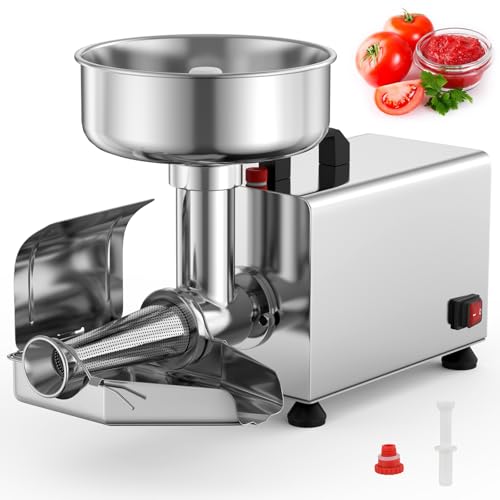
- 450W motor rated for 200–350 pounds per hour
- 304 stainless steel food-contact construction
- Tool-free disassembly with dishwasher-safe parts
Best For: High-volume tomato and fruit processing
Most Versatile
Johnny Model 250 Electric Food Strainer

- Electric motor with hand-crank backup
- Multiple screens for sauces and purees
- Five-year warranty and sturdy clamp mount
Best For: Home cooks processing varied fruits and vegetables
Most Multifunctional
AIRMSEN Electric Tomato Sauce Press

- Tomato strainer plus meat-grinder functions
- Includes sausage and kibbeh accessories
- Reverse function and non-slip feet
Best For: Kitchens needing one appliance for several preparations
Best Simple Setup
Johnny Model 250 Electric Strainer

- Focused apple/tomato screen included
- Electric motor and hand-crank options
- Five-year warranty with clamp mounting
Best For: Routine tomato sauce and puree preparation
Bulk-Batch Value

- Processes up to 200 pounds per hour
- Separates seeds and peels in one pass
- Large hopper and tool-free disassembly
Best For: High-volume home sauce making and bulk canning
Commercial-Style Workhorse
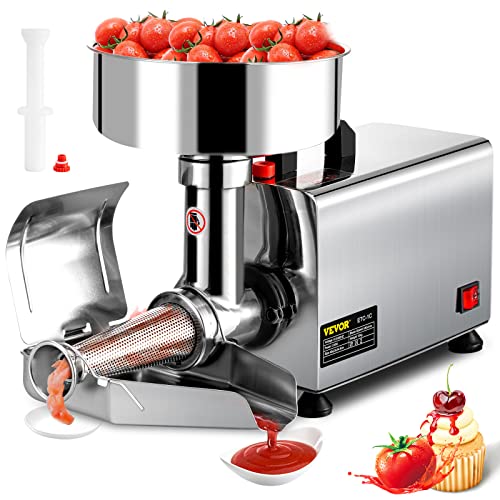
- 370W pure copper motor
- 9-inch feeding funnel
- Adjustable trough helps control discharge
Best For: Frequent sauce and jam preparation
High-Capacity Pick

- Processes up to 330 pounds per hour
- Automatic dual-channel skin and seed separation
- Five-year warranty and lifetime support
Best For: Large-batch canning and commercial-style processing
Italian Workhorse – Reber N.3 Electric Tomato Strainer
For shoppers comparing electric tomato presses, the Reber N.3 stands out as a high-capacity Italian-made option for sauce, preserves, jams, and fruit juices. Its 450W induction motor is designed for continuous operation and is rated to process up to 309 pounds of tomatoes per hour.
Best For: Large-batch home cooks and gardeners who want a durable, multifunctional tomato strainer.
Pros:
- Continuous-duty 450W induction motor with up to 309 pounds-per-hour capacity
- Durable cast iron body and stainless steel AISI 304 components
- Long Life oil-bath gearbox is designed for maintenance-free operation
- Optional accessories can expand its use beyond tomato processing
Cons:
- At 21 pounds, it is relatively substantial for a countertop appliance
- Hand-wash care may require more cleanup time
- Additional attachments are optional rather than included
The Reber is a strong choice when throughput, construction, and long-term versatility matter more than compact size. Its robust materials and continuous motor make it especially suitable for serious preserving sessions.
Compact Italian Preserver – OMRA Spremy Model 850
The OMRA Spremy Model 850 is one of the more compact electric tomato presses for separating puree from tomato skins and seeds. Its 1/4 HP motor uses a 110 RPM masticating-style rotation and is rated for production of up to 330 pounds of tomatoes per hour.
Best For: Users seeking a compact Italian-made strainer for tomato puree and soft-fruit processing.
Pros:
- Rated capacity of up to 330 pounds, or 150 kilograms, per hour
- Separates puree from skins and seeds automatically
- Die-cast metal housing and stainless steel hopper
- Cooling fan supports the 1/4 HP motor
Cons:
- The listed 220-volt power requirement may limit compatibility in some kitchens
- Its compact specifications provide less detail about included screens or accessories
- Recommended uses are narrower than multifunction models
The OMRA offers impressive stated throughput in a small footprint, making it appealing where counter space is limited. Check the electrical requirements carefully before purchasing.
Versatile Batch Maker – Weston Deluxe Electric Tomato Strainer
The Weston Deluxe is a practical electric tomato press for home canning, preserving, sauces, jams, jellies, and salsa. Its 250W motor offers forward and reverse speeds, while the one-gallon hopper and three included stainless steel screens support different textures and ingredients.
Best For: Home preservers who want flexible straining options and convenient jam, puree, and salsa preparation.
Pros:
- One-gallon hopper accommodates larger batches
- Forward and reverse motor speeds help with feeding and jam prevention
- Includes 1.5mm, 3mm, and 6mm stainless steel screens
- Designed to remove skins and separate seeds without coring
Cons:
- Its 250W motor has less stated power than the 450W models in this roundup
- Plastic construction may feel less heavy-duty than cast iron or full stainless steel
- Limited to a one-year manufacturer warranty
The Weston is a well-rounded choice for households that value adjustable results over maximum commercial-style throughput. The included screens make it particularly useful for varied preserving projects.
Commercial-Style Stainless Steel – COSTWAY 450W Tomato Strainer
The COSTWAY 450W is a commercial-style option among electric tomato presses, with a large 8.5-inch feed chute and a stated processing range of 200 to 350 pounds per hour. It is built for tomatoes and soft fruits such as strawberries, blueberries, and pineapples.
Best For: High-volume processing and users who prioritize stainless steel construction and easier disassembly.
Pros:
- 450W full-copper motor with a stated 200–350 pounds-per-hour range
- Food-grade 304 stainless steel construction
- Tool-free disassembly and dishwasher-safe detachable parts
- Safety pusher, enclosed motor guard, anti-slip feet, and insulated switch
Cons:
- At 22 pounds, it is not especially lightweight
- Product-care instructions specify hand washing despite dishwasher-safe detachable parts
- Its larger commercial-style design may be more machine than occasional users need
The COSTWAY combines high stated throughput with safety features and stainless steel parts, making it a compelling fit for substantial harvests. Its size and capacity are best matched to frequent or high-volume preserving.
Most Versatile – Johnny Model 250 Electric Food Strainer
For shoppers comparing electric tomato presses, the Johnny Model 250 stands out as a versatile food strainer with an included motor and multiple screens. It separates skins and seeds while handling sauces, purees, juices, jams, soups, and baby food.
Best For: Home cooks who want one electric strainer for tomatoes and a broad range of fruits and vegetables.
Pros:
- Includes an electric motor plus a hand-crank option.
- Comes with berry, apple/tomato, pumpkin, and salsa screens.
- Sturdy cast-aluminum body, stainless steel screens, and a five-year warranty.
- Clamp mounts to countertops from 3/4 to 2-1/8 inches thick.
Cons:
- The larger accessory set may be more than needed for shoppers focused only on tomato sauce.
- Its clamp-based design requires a compatible countertop edge.
This is a strong all-purpose choice when flexibility matters. The included tomato screen and electric motor make it suitable for sauce preparation, while the additional screens broaden its usefulness for seasonal preserving.
Most Multifunctional – AIRMSEN Electric Tomato Sauce Press
The AIRMSEN combines an electric tomato press with a meat grinder, sausage maker, and kibbeh tool. Its tomato strainer attachment suits shoppers who want a multipurpose countertop appliance rather than a dedicated sauce machine.
Best For: Home kitchens that need tomato pressing alongside meat grinding and sausage-making functions.
Pros:
- Combines tomato sauce processing, meat grinding, sausage making, and kibbeh preparation.
- Includes three grinding plates for different textures.
- Reverse function helps clear jams, while rubber feet improve stability.
- Detachable parts and a safety-lock knob support straightforward operation.
Cons:
- Parts are not dishwasher safe and are recommended for hand washing.
- The supplied details list 2500W peak motor power but 300 watts in the specifications, so power claims should be checked carefully.
- Its broader meat-grinder design may be less specialized than a dedicated tomato strainer.
The AIRMSEN makes the most sense for buyers who value multiple food-preparation functions. Choose it over a dedicated press if meat grinding and sausage accessories are equally important to your kitchen.
Best Simple Setup – Johnny Model 250 Electric Strainer
This Johnny Model 250 is a straightforward option among electric tomato presses, pairing an electric motor with a clamp-mounted strainer. It includes the apple/tomato screen and is designed to separate skins and seeds for sauces, purees, juices, and similar preparations.
Best For: Tomato-sauce makers who want a simpler electric strainer with a focused accessory package.
Pros:
- Includes both an electric motor and hand-crank operation.
- Apple/tomato screen has 1.3mm openings for separating skins and seeds.
- Cast-aluminum body and stainless steel screen are built for repeated kitchen use.
- Includes a five-year warranty and a clamp for countertops 3/4 to 2-1/8 inches thick.
Cons:
- Includes fewer screens than the more accessory-rich Johnny package.
- The clamp mount requires a suitable countertop edge.
- It is less versatile for specialized textures than a model with multiple screens.
With its focused tomato screen and electric motor, this version is a practical fit for routine sauce making. It is especially appealing when you want the Johnny strainer format without the expanded screen assortment.
Bulk-Batch Value – VEVOR 370W Tomato Strainer
For shoppers comparing electric tomato presses for harvest-season canning, the VEVOR offers a 370W motor, a large hopper, and a stated capacity of up to 200 pounds per hour. Its stainless steel screen separates peels and seeds in one pass for smoother sauces, purees, and juices.
Best For: High-volume home sauce making and bulk canning.
Pros:
- Separates pulp and seeds from peels for smoother results.
- Large hopper helps reduce refills during batch processing.
- Stainless steel hopper, screen, tray, and guard are suited to frequent use.
- Core parts disassemble without tools for easier rinsing.
Cons:
- Ingredients should be cut into small pieces to help reduce clogging.
- At 21.7 pounds, it is not especially lightweight for storage or setup.
The VEVOR is a practical choice when throughput and reduced manual straining matter most. It combines useful batch capacity with accessible cleanup, though prep work is still important for smooth operation.
Commercial-Style Workhorse – VBENLEM 370W Tomato Press
Among electric tomato presses, the VBENLEM stands out for its 370W pure copper motor, 9-inch feeding funnel, and stainless steel food-contact components. The adjustable trough is designed to guide sauce smoothly while helping limit splashing during processing.
Best For: Frequent sauce and jam preparation with adjustable dispensing.
Pros:
- 304 stainless steel food-contact parts support durable processing.
- Pure copper motor is rated at 370W for demanding batches.
- Wide 9-inch funnel allows more convenient feeding.
- Adjustable trough and brace help direct sauce and reduce splashing.
Cons:
- The listing gives a broad 90–160 kg/h range rather than one fixed throughput figure.
- Although described as stainless steel, the material details also identify the machine as aluminum.
- Its 22-pound weight may make frequent repositioning less convenient.
The VBENLEM is suited to buyers who value a sturdy commercial-style design and more control over sauce discharge. Its wide funnel and adjustable trough are particularly useful when processing sauces or jams regularly.
High-Capacity Pick – ARINOO 450W Tomato Strainer
If you need electric tomato presses for larger batches, the ARINOO combines a 450W pure copper motor with a stated capacity of up to 330 pounds per hour. Its dual-channel design separates skins and seeds automatically, while the food-grade 304 stainless steel construction is built for repeated sauce, jam, and puree processing.
Best For: Large-batch home canning, farm use, restaurants, and commercial kitchens.
Pros:
- Higher stated throughput of up to 330 pounds per hour.
- Dual-channel straining removes skins and seeds without an extra filter step.
- 304 stainless steel construction is rust-resistant and food-grade.
- Includes a food pusher, safety guard, and five-year manufacturer warranty.
Cons:
- Continuous operation should be limited to 15 minutes followed by a five-minute cooldown.
- Ingredients may need to be cut smaller, and firmer fruits may require cooking first.
- Hand-wash care is specified.
The ARINOO offers the strongest stated capacity in this group and adds a substantial warranty for buyers planning frequent use. Its cooldown requirement and hand-wash care are worth factoring into a high-volume workflow.
How We Picked the Best Electric Tomato Presses
We focused on the features that matter most when processing fresh tomatoes: motor power, stated capacity, feed and hopper design, auger and screen materials, stability, cleanup, and compatibility with household electrical systems. We also considered whether each machine is designed strictly for tomatoes or can handle other soft produce, such as apples, berries, grapes, pumpkin, or cooked vegetables.
Performance claims vary by tomato variety, ripeness, preparation, and operator technique, so published pounds-per-hour figures are useful for comparison but should not be treated as guaranteed results. Models with stainless-steel components and replaceable screens generally offer better long-term value for frequent preserving.
Quick Comparison
- For frequent preserving: Look for a higher-powered motor, a sturdy frame, and a large hopper.
- For occasional home use: A compact electric strainer can reduce setup, storage, and cleanup demands.
- For versatile food processing: Choose a model that supports fruit, vegetables, sauces, or grinding attachments.
- For large harvests: Prioritize throughput, continuous-feed operation, cooling design, and easy access to replacement parts.
Key Buying Factors for Electric Tomato Presses
Motor Power and Throughput
Wattage gives a rough indication of motor strength, but it does not tell the whole story. Auger design, screen size, tomato preparation, and duty cycle also affect output. A 370W to 450W machine may be suitable for many household batches, while heavy users should look for durable construction and clear operating limits rather than relying on wattage alone.
Materials and Stability
Stainless steel or strong food-contact components are easier to maintain and better suited to acidic tomato juice. A heavy base, clamp, or non-slip feet help prevent movement during operation. Check that the hopper, chute, screen, and auger can be removed without complicated tools.
Screen and Separation Design
The screen determines how effectively the machine separates seeds and skins from pulp. Confirm what screens are included and whether replacements are available. Some presses produce a thicker sauce, while others prioritize a smoother juice or purée, so screen design should match your recipes.
Electrical and Cleanup Requirements
Verify voltage before ordering, especially when comparing imported or commercial-style machines. Consider cord length, overload protection, splash control, and how quickly the food-contact parts can be rinsed. Prompt cleaning helps prevent pulp from drying inside the screen and auger.
Who Should Buy Which Electric Tomato Presses?
Choose a compact home-oriented press if you process a few batches each season and want simpler storage. Choose a higher-capacity commercial-style model if you regularly preserve garden harvests, supply family members, or value faster continuous processing. Choose a versatile food mill or grinder combination if you want one appliance for tomatoes plus applesauce, salsa, purées, or other prepared foods.
Before buying, compare the machine’s voltage, rated capacity, included accessories, warranty, and replacement-part availability. The best electric tomato press is not necessarily the fastest model; it is the one that safely handles your typical batch size without creating more setup and cleanup work than it saves.