Small-batch sauce, preserve, and purée businesses need equipment that removes skins and seeds efficiently without creating unnecessary cleanup or downtime. The right food strainer can turn seasonal produce into consistent products faster than manual milling.
We selected 10 electric and manual machines spanning compact sauce makers, clamp-based models, and higher-capacity stainless-steel units. Use the guide below to match throughput, construction, power requirements, and maintenance demands to your operation.
Best 10 Food Strainer Machines for Small Businesses Picks for 2026
Compact Italian Tomato Specialist
OMRA Spremy Electric Tomato Strainer

- Processes up to 330 pounds of tomatoes per hour
- Separates puree from seeds and skins automatically
- Compact metal-and-stainless construction
Best For: Small businesses focused on tomato puree production
Manual Batch Sauce Maker
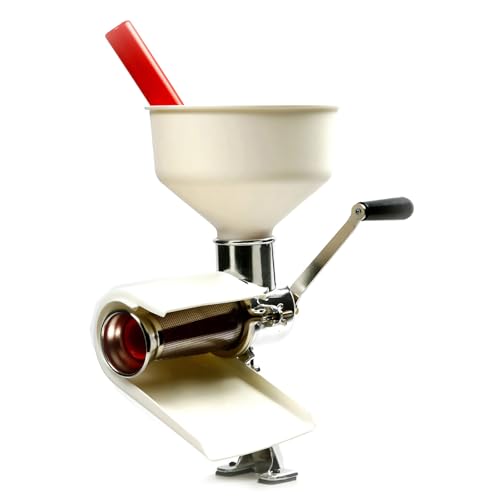
- 3-quart capacity for small batches
- Separates juice and pulp manually
- Includes fine screen and standard spiral
Best For: Low-volume sauce, puree, and produce preparation
High-Throughput Stainless Workhorse
COSTWAY 450W Electric Strainer
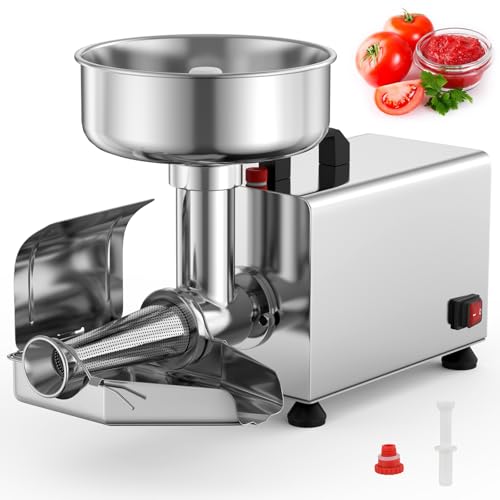
- Rated for 200–350 pounds of sauce per hour
- 304 stainless steel food-contact construction
- Tool-free disassembly with dishwasher-safe parts
Best For: Small commercial kitchens processing sauces and preserves
Durable Italian Production Press
Reber N.3 Electric Tomato Strainer

- Processes up to 309 pounds per hour
- 450W induction motor supports continuous operation
- Durable cast iron and AISI 304 stainless components
Best For: Recurring high-volume sauce and preserve production
Best Manual Batch Strainer
Weston Stainless Steel Tomato Strainer
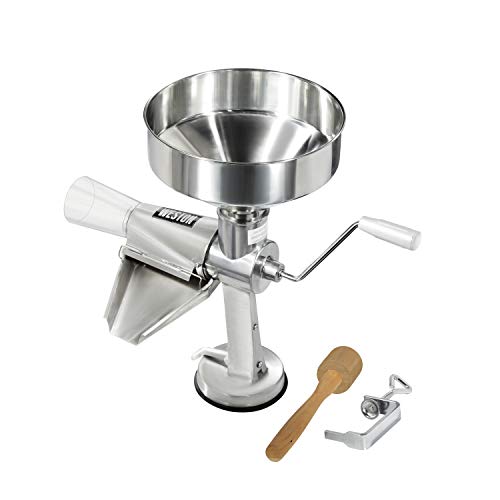
- One-gallon hopper for batch processing
- Dual suction-cup and C-clamp mounting
- Includes stomper and 1.5mm screen
Best For: Manual sauce, puree, jam, and salsa production
Best Motorized Clamp Model
Johnny Apple Sauce Maker with Motor

- Electric motor plus hand-crank operation
- 1.3mm screen separates skins and seeds
- Clamps to counters 3/4 to 2-1/8 inches thick
Best For: Flexible small-kitchen sauce and puree production
Best Electric High-Volume Option
Weston Deluxe Electric Tomato Strainer

- 250-watt motor with forward and reverse speeds
- One-gallon hopper for large batches
- Includes three screen sizes
Best For: Powered sauce, puree, jelly, and salsa production
Best All-Stainless Build
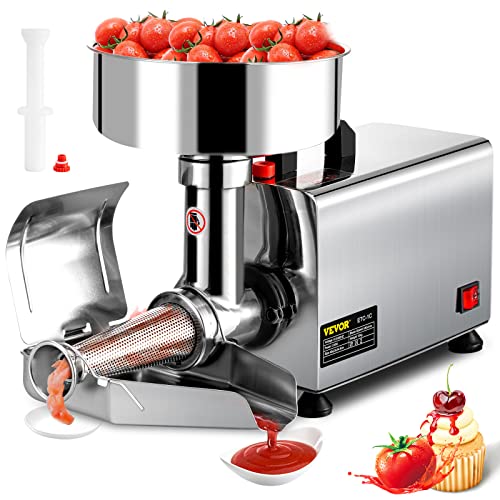
- 304 stainless steel food-contact parts
- 370W copper motor
- Adjustable trough and 9-inch funnel
Best For: Small-batch commercial sauce and jam production
Best for Easy Batch Processing

- Stainless screen separates skins and seeds
- Large hopper supports fewer refills
- Tool-free disassembly for cleaning
Best For: Repeat tomato sauce, puree, and jam batches
Best High-Output Option
450W Commercial Tomato Strainer

- Rated for 200–350 pounds per hour
- 304 stainless steel construction
- Tool-free, dishwasher-compatible cleanup
Best For: Higher-volume sauce, puree, and preserve production
Compact Italian Tomato Specialist – OMRA Spremy Electric Tomato Strainer
For small businesses seeking food strainer machines for small businesses, the OMRA Spremy is a compact electric option focused on tomato and apple processing. Its 1/4 HP motor and masticating-style auger are rated for up to 330 pounds per hour.
Best For: Small producers processing fresh or cooked tomatoes into puree, with occasional apple use.
Pros:
- Separates tomato puree from seeds and skins automatically.
- Processes up to 330 pounds of tomatoes per hour.
- Includes a stainless steel hopper, die-cast metal housing, and food-grade nylon auger.
- Cooling-fan-equipped motor and portable design.
Cons:
- Its listed 220-volt power requirement may limit compatibility with some outlets.
- Its stated applications are narrower than machines designed for broader food processing.
The OMRA is a focused, space-conscious choice when tomato straining is the primary task. Verify electrical compatibility before purchasing.
Manual Batch Sauce Maker – Norpro 1951 Sauce Master
The Norpro 1951 is a manual food strainer machine for small businesses that need modest batch capacity without an electric motor. It presses fruits and vegetables through a chrome-plated steel screen to separate juice and pulp.
Best For: Small-batch sauce, puree, fruit, and vegetable preparation where manual operation is acceptable.
Pros:
- Handles vegetables, fruits, and purees in one operation.
- Includes a fine mesh screen, standard spiral, recipes, and instructions.
- Offers a 3-quart or 95-ounce capacity.
- Additional berry, pumpkin, and salsa screens are available separately.
Cons:
- Manual operation is less suited to continuous high-volume production.
- Hand-wash-only care adds cleanup time.
- Additional screens require separate purchases.
This Sauce Master suits businesses that value a simple, non-electric setup and flexible small-batch use. Its capacity and manual design make it better for limited production than large processing runs.
High-Throughput Stainless Workhorse – COSTWAY 450W Electric Strainer
The COSTWAY 450W electric strainer is built for small businesses needing food strainer machines for small businesses with higher throughput. Its full-copper motor and large feed chute are rated to produce 200 to 350 pounds of sauce per hour.
Best For: Commercial-style processing of tomatoes and soft fruits for sauces, jams, and preserves.
Pros:
- Rated for 200 to 350 pounds of sauce per hour.
- Uses food-grade 304 stainless steel construction.
- Tool-free disassembly and dishwasher-safe detachable parts simplify cleaning.
- Safety features include a motor guard, anti-slip feet, insulated switch, and included pusher.
Cons:
- At 22 pounds, it is less convenient to move than a lightweight countertop tool.
- The product-care instructions also specify hand washing, despite dishwasher-safe detachable parts.
- Its 20.5-inch depth requires adequate workspace.
With its high stated output and stainless construction, the COSTWAY is a strong fit for recurring sauce and preserve production. Confirm that your workspace can accommodate its larger footprint.
Durable Italian Production Press – Reber N.3 Electric Tomato Strainer
The Reber N.3 is a durable food strainer machine for small businesses that need continuous tomato processing and preserve production. Its 450W induction motor is rated for up to 309 pounds of tomatoes per hour, with an oil-bath gearbox designed for long-life operation.
Best For: Businesses producing tomato sauce, jams, and fruit juices in larger recurring batches.
Pros:
- Continuous motor operation with a stated capacity of up to 309 pounds per hour.
- Features a maintenance-free oil-bath gearbox.
- Uses a cast iron body, AISI 304 stainless steel components, and heat-resistant acetal resin auger.
- Compatible optional attachments can expand its use beyond straining.
Cons:
- Hand-wash-only care may require more cleanup effort.
- At 21 pounds, it is not the lightest option for frequent repositioning.
- Optional attachments are separate accessories.
The Reber stands out for continuous-duty design, durable materials, and potential expansion with compatible attachments. It is a practical choice for businesses that process substantial batches and prioritize long-term equipment construction.
Best Manual Batch Strainer – Weston Stainless Steel Tomato Strainer
For small businesses seeking food strainer machines for small businesses without adding a motor, this Weston model offers a practical manual setup. Its one-gallon hopper, stainless steel construction, and dual mounting system support batch processing of tomatoes, apples, and other soft produce.
Best For: Small-batch sauce, puree, jam, salsa, and preserve production where manual operation is acceptable.
Pros:
- One-gallon hopper handles relatively large batches.
- Dual mount uses either a suction-cup base or C-clamp.
- Includes a stomper and 1.5mm multipurpose screen.
- Processes produce without peeling or coring first.
Cons:
- Manual cranking requires more operator effort than electric models.
- Additional screens are sold separately.
This is a useful choice for businesses that value straightforward stainless steel construction and flexible mounting over powered throughput. Its one included screen may limit versatility until accessories are added.
Best Motorized Clamp Model – Johnny Apple Sauce Maker with Motor
Businesses comparing food strainer machines for small businesses may appreciate the flexibility of this Johnny Apple Sauce Maker. It can be operated by hand or with the included electric motor, while its clamp design secures to countertops between 3/4 and 2-1/8 inches thick.
Best For: Small commercial kitchens that want both electric convenience and manual backup for sauces, purees, fillings, juices, and jams.
Pros:
- Includes an electric motor while retaining hand-crank operation.
- Separates skins and seeds from a variety of fruits and vegetables.
- Clamp provides 10 square inches of clamping surface.
- Includes a 1.3mm apple/tomato screen and standard spiral.
Cons:
- Clamp mounting requires a compatible countertop thickness.
- Includes one screen, so other textures may require additional accessories.
- Its cast aluminum body may be less uniformly stainless steel than some alternatives.
The combination of powered and manual operation makes this a versatile option when workloads vary. Verify that the available counter can accommodate the stated clamp range before purchasing.
Best Electric High-Volume Option – Weston Deluxe Electric Tomato Strainer
For small businesses needing food strainer machines for small businesses with faster powered processing, the Weston Deluxe combines a 250-watt motor with a one-gallon hopper. Its forward and reverse speeds and three included screens make it suited to varied sauce, puree, jelly, and salsa work.
Best For: Businesses processing larger batches of tomatoes and soft produce with different puree and salsa textures.
Pros:
- 250-watt motor offers two speeds for processing and jam prevention.
- One-gallon hopper supports batch work.
- Includes 1.5mm, 3mm, and 6mm stainless steel screens.
- Stomper helps push food safely into the hopper.
Cons:
- Requires access to a 120-volt power supply.
- Electric operation may be more equipment than occasional users need.
- Covered by a one-year warranty.
This is the strongest fit of the three for repeat powered production and adjustable results. The multiple screens add useful flexibility, while the 120-volt electrical requirement should be planned for in the workspace.
Best All-Stainless Build – VBENLEM 370W Tomato Strainer
For small businesses seeking food strainer machines for small businesses, the VBENLEM combines a 370W copper motor with food-contact 304 stainless steel parts. Its adjustable discharge trough and 9-inch funnel support steady sauce and puree production.
Best For: Small-batch commercial kitchens processing tomatoes, berries, and jams.
Pros:
- Food-contact components use 304 stainless steel.
- 370W motor is designed for tomato milling and sauce making.
- Adjustable trough helps direct sauce into a container.
- Components are designed for disassembly and cleaning.
Cons:
- Its listed capacity is 100 kg, which may be limiting for higher-volume operations.
- The machine is designed primarily around tomatoes, sauces, and jams.
With a 22-pound build and relatively compact footprint, this model is a practical option when durability and straightforward cleanup matter more than maximum throughput.
Best for Easy Batch Processing – VEVOR 370W Tomato Strainer
The VEVOR is one of the more practical food strainer machines for small businesses that need repeatable tomato processing. Its stainless steel screen separates skins and seeds in one pass, while the large hopper helps reduce refilling during batch work.
Best For: Small commercial operations making tomato sauce, puree, juice, and fruit jams.
Pros:
- Stainless steel screen separates peels and seeds for smoother output.
- 370W motor supports bulk sauce making and canning.
- Large hopper can reduce frequent refills.
- Core components disassemble without tools for quick rinsing.
Cons:
- Tomatoes should be cut into small pieces to help reduce clogging.
- Its listed capacity is 90 kg, below the highest-output option in this roundup.
This is a sensible choice for businesses prioritizing a streamlined workflow: load the hopper, separate pulp from skins and seeds, and clean the removable components after processing.
Best High-Output Option – 450W Commercial Tomato Strainer
For small businesses needing higher throughput from food strainer machines for small businesses, this 450W model is rated to process 200–350 pounds of sauce per hour. Its 304 stainless steel construction, safety features, and dishwasher-compatible detachable parts suit busy sauce and preserve production.
Best For: Higher-volume kitchens processing tomatoes and multiple fruits for sauces, purees, and jams.
Pros:
- 450W all-copper motor is rated for 200–350 pounds per hour.
- 8.5-inch feed chute supports efficient loading.
- Enclosed motor guard, insulated switch, and anti-slip feet improve operational safety.
- Tool-free disassembly and dishwasher-compatible parts simplify cleanup.
Cons:
- Its larger footprint may require more counter space.
- The higher-output design may be more capacity than very small operators need.
This model stands out when production volume is the priority. It also offers flexibility beyond tomatoes, handling strawberries, blueberries, pineapples, and other ingredients for varied product lines.
How We Picked the Best Food Strainer Machines for Small Businesses
We compared the selected machines on the factors that matter most in a working kitchen or small production space: motor power, stated processing capacity, hopper and body materials, straining design, batch workflow, stability, cleaning requirements, and electrical compatibility. We also considered whether each model suits occasional seasonal use, regular farmers-market production, or more demanding commercial workloads.
Published capacity figures are useful for broad comparisons, but real output varies with produce type, ripeness, preparation, screen selection, and how continuously the machine can be fed. Treat advertised pounds-per-hour ratings as a starting point rather than a guaranteed production rate.
Quick Comparison
| Best For | What to Prioritize | Typical Choice |
|---|---|---|
| Seasonal home-based sales | Compact size, simple cleanup, manageable cost | Lower-power electric or clamp-based model |
| Regular sauce production | Durable auger, stable base, efficient feed system | Mid-range electric strainer |
| Higher-volume batches | Stainless construction, larger hopper, higher throughput | Commercial-grade 370W–450W machine |
| Mobile or limited-power setups | Portability and compatible electrical supply | Compact unit with straightforward controls |
Key Buying Factors for Food Strainer Machines for Small Businesses
Capacity and Workflow
Estimate your largest realistic batch, not just your average one. A larger hopper and faster feed can reduce labor, but only if you have enough prepared produce and collection containers to keep the machine running. For modest production, an oversized machine may take up valuable workspace without improving efficiency.
Motor Power and Duty Cycle
Higher wattage can help process dense or fibrous produce, but motor design, auger geometry, and cooling also matter. Check whether the unit is intended for continuous operation and allow for breaks if the manufacturer recommends them. Confirm that the voltage matches your business location and outlet capacity.
Materials and Durability
Stainless-steel contact parts are valuable for frequent food processing because they resist corrosion and are easier to sanitize. Inspect the hopper, screen, auger, clamps, and collection chute. A sturdy base or secure clamp is especially important when processing firm or unevenly prepared produce.
Screen Options and Cleanup
Choose a machine with a screen suited to your products and verify whether additional screens are available. Removable parts simplify cleaning, while crevices around the auger and seals can add labor. Clean the machine promptly after use and follow the manufacturer’s instructions for components that should not be submerged.
Who Should Buy Which Food Strainer Machines for Small Businesses?
Choose a compact electric or clamp-based sauce maker if you produce limited seasonal quantities, have restricted counter space, or value easy storage. These models are practical for test batches, direct-to-consumer sales, and businesses still refining their product line.
Choose a mid-power electric strainer for recurring weekly production where consistent output and reduced manual work matter more than maximum capacity. For larger orders, catering, farm stands, or wholesale preparation, prioritize a stainless commercial-grade machine with a generous hopper, stable construction, and a published throughput appropriate to your volume.
Before buying, confirm included accessories, replacement-screen availability, warranty support, cleaning procedures, and your local power requirements. The best Food Strainer Machines for Small Businesses are not necessarily the fastest; they are the ones that deliver reliable output while fitting your space, staff, budget, and sanitation routine.