The best electric food mills make it easier to turn cooked tomatoes, fruits, and other ingredients into smooth sauces without the repetitive work of manual straining. This roundup includes tomato presses, sauce makers, meat grinders, and high-powered pulverizers for different kitchen and food-processing needs.
Because capacity, motor power, materials, and intended ingredients vary widely, compare each model’s design and output before buying. The right choice depends on whether you process occasional batches at home or need commercial-style performance.
Best 10 Electric Food Mills Picks for 2026
High-Volume Tomato Specialist
OMRA Spremy Electric Tomato Strainer

- Separates puree from tomato skins and seeds
- Processes up to 330 pounds per hour
- Metal housing with stainless steel hopper
Best For: Large-batch tomato sauce and puree making
Meat-Processing Alternative
Cuisinart Electric Meat Grinder

- 300-watt motor grinds up to 3 pounds per minute
- Includes medium and coarse cutting plates
- Comes with two sausage attachments
Best For: Home meat grinding and sausage making
Versatile Sauce Maker
Weston Deluxe Electric Tomato Strainer

- One-gallon hopper for larger batches
- Includes three stainless steel screens
- Forward and reverse 250-watt motor
Best For: Sauces, purees, salsa, jellies, and preserving
Dry-Ingredient Power Grinder
VEVOR Electric Grain Mill Grinder

- 2,100-watt motor reaches 28,000 RPM
- Grinds dry grains, spices, coffee, and cereals
- Timed controls and 30–300 mesh fineness
Best For: High-speed grinding of dry ingredients
Best Multi-Screen Option

- Four screens support different sauce textures
- Processes up to 88 pounds per hour
- 304 stainless steel parts with splash guard
Best For: Home canners making sauces, salsa, puree, or jam
Best High-Output Choice
ETC-1C 450W Electric Tomato Strainer

- 200–350 pounds per hour stated output
- 8.5-inch chute supports continuous feeding
- 304 stainless steel parts and tool-free cleanup
Best For: Large-batch canning, small businesses, and restaurant use
Best Large-Hopper Value

- Large hopper reduces refill frequency
- Stated output reaches 200 pounds per hour
- Tool-free disassembly simplifies rinsing
Best For: Frequent home canning and bulk fruit or vegetable processing
Best Multi-Function Pick
AIRMSEN Electric Meat Grinder and Tomato Press

- Four functions: grinding, sausage, kibbeh, and tomato sauce
- Three grinding plates for varied textures
- Reverse function and non-slip feet aid operation
Best For: Home cooks needing one appliance for several food-prep tasks
Best High-Volume Pick
COSTWAY Commercial Tomato Strainer
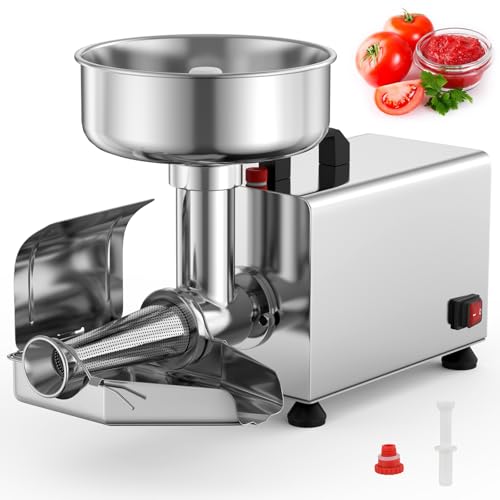
- Processes a stated 200–350 pounds per hour
- 450W motor and 8.5-inch feed chute support batch work
- 304 stainless-steel body with tool-free disassembly
Best For: Large-batch sauce and jam preparation
Best Stainless-Steel Value
VBENLEM Electric Tomato Strainer
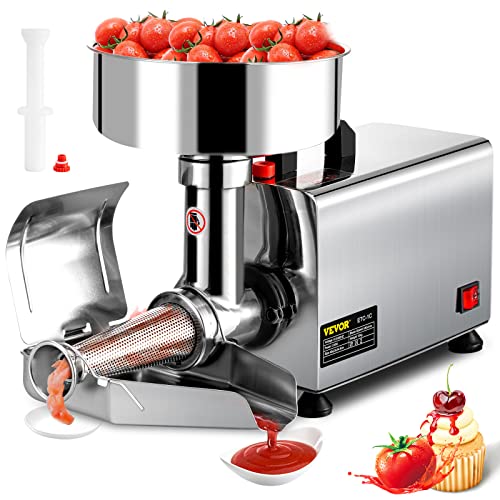
- 304 stainless-steel food-contact components
- 9-inch funnel and adjustable discharge trough
- 370W copper motor for tomato and fruit sauces
Best For: Dedicated tomato, ketchup, and fruit-jam processing
High-Volume Tomato Specialist – OMRA Spremy Electric Tomato Strainer
Among electric food mills, the OMRA Spremy stands out for tomato-focused processing. Its masticating-style worm separates puree from skins and seeds, while the 1/4 HP motor is rated for processing up to 330 pounds of tomatoes per hour.
Best For: Home gardeners and preservers processing large batches of fresh or cooked tomatoes.
Pros:
- Separates tomato puree from seeds and skins automatically.
- Rated capacity of up to 330 pounds per hour.
- Die-cast metal housing, stainless steel hopper, and food-grade nylon auger.
- Made in Italy with a cooling-fan-equipped motor.
Cons:
- Designed primarily for tomatoes and similar soft produce.
- Uses a 220-volt power supply, which may not suit every kitchen.
The OMRA is a specialized, high-capacity option rather than a general-purpose mill. Choose it when tomato sauce and puree production are the priority and your electrical setup supports its 220-volt requirement.
Meat-Processing Alternative – Cuisinart Electric Meat Grinder
The Cuisinart is a meat grinder rather than a traditional produce mill, but it can suit shoppers comparing electric food mills for broader kitchen processing. Its 300-watt motor handles up to 3 pounds of meat per minute and includes medium and coarse plates.
Best For: Home cooks who want an electric grinder for beef, poultry, venison, and homemade sausage.
Pros:
- Grinds beef, chicken, turkey, venison, and other meats.
- Processes up to 3 pounds per minute.
- Includes medium and coarse metal cutting plates.
- Reverse function helps release clogged food, and two sausage attachments are included.
Cons:
- It is intended for meat grinding, not straining fruits or vegetables.
- Its 3-pound capacity is smaller than high-volume produce-focused machines.
This is a practical choice only if your definition of an electric food mill includes meat preparation. For tomato puree or seed-and-skin separation, a dedicated tomato strainer will be a better match.
Versatile Sauce Maker – Weston Deluxe Electric Tomato Strainer
The Weston Deluxe is one of the more versatile electric food mills for preserving and sauce preparation. It removes skins and seeds from soft produce, offers two speeds with reverse, and includes three stainless steel screens for fine, smooth, or chunkier results.
Best For: Canning, preserving, and making tomato sauces, purees, jellies, and salsa in larger batches.
Pros:
- One-gallon hopper supports larger batches.
- Three screens cover 1.5mm, 3mm, and 6mm processing needs.
- 250-watt motor provides forward and reverse speeds.
- Includes a stomper for feeding produce safely.
Cons:
- Its 14-by-12-by-17-inch footprint requires dedicated storage space.
- Plastic and stainless-steel construction may feel less heavy-duty than an all-metal unit.
With multiple screens and a reverse function, the Weston offers useful flexibility for preserving projects. It is a strong fit for shoppers who want more than basic tomato straining without moving to a commercial-scale machine.
Dry-Ingredient Power Grinder – VEVOR Electric Grain Mill Grinder
The VEVOR is a dry-ingredient grinder, not a produce strainer, but it belongs in an electric food mills comparison for shoppers seeking fine powders. Its 2,100-watt, 28,000-RPM motor is designed for grains, spices, coffee, and other dry ingredients, with timed operation and adjustable fineness.
Best For: Grinding dry grains, spices, cereals, coffee beans, corn, and pepper into fine powders.
Pros:
- Handles a broad range of dry grains and spices.
- Offers 5-, 15-, and 30-second timing options.
- Three stainless-steel blades and a 270-degree shaking design support even grinding.
- Grinding fineness ranges from 30 to 300 mesh.
Cons:
- Not suitable for wet, oily, or sticky ingredients.
- Continuous operation is limited to five minutes followed by a recommended rest.
- Its high-speed pulverizing design is unsuitable for separating fruit skins and seeds.
The VEVOR is best viewed as a powerful dry mill rather than a traditional food strainer. It makes sense when powder production is the goal, but not when you need smooth tomato puree or other wet-food separation.
Best Multi-Screen Option – VEVOR 800W Tomato Strainer
If you want electric food mills for sauces with different textures, this VEVOR model stands out for its four included screens. It separates peels and seeds in one pass, while its stainless steel construction and splash-reducing cover make larger sauce-making sessions more manageable.
Best For: Home canners who want multiple screen sizes for tomato sauce, salsa, puree, jam, and other preparations.
Pros:
- Includes 1 mm, 1.5 mm, 3 mm, and 6 mm screens for varied textures.
- Processes up to 88 pounds per hour for larger batches.
- Uses durable 304 stainless steel components and includes a cleaning brush.
- Guard cover helps reduce splatter during straining.
Cons:
- The listed 800W maximum and 300W rated power may require careful comparison with other models.
- Its 7.2-pound weight may be less convenient for frequent moving.
This is a versatile pick when screen selection matters most. The tool-free removable core components and steady, low-noise DC motor also make it practical for repeated harvest-season processing.
Best High-Output Choice – ETC-1C 450W Electric Tomato Strainer
Among electric food mills for serious batch processing, this 450W ETC-1C emphasizes output and continuous feeding. Its wide feed chute, pure copper motor, stainless steel food-contact parts, and automatic operation suit home canning, small-business production, and restaurant use.
Best For: Users processing large quantities of tomatoes, berries, or soft fruit into sauce, jam, or juice.
Pros:
- Rated for approximately 200–350 pounds per hour of output.
- Wide 8.5-inch feed chute supports continuous feeding.
- 304 stainless steel food-contact components resist corrosion and help keep flavors clean.
- Tool-free assembly, dishwasher-safe detachable parts, anti-slip feet, and a waterproof switch support easier operation.
Cons:
- At 20.9 pounds, it is substantially heavier than the other listed options.
- The supplied notes identify sauce, jam, and mincing uses but do not specify multiple screen sizes.
This model is geared toward throughput rather than compact storage. The large chute and high stated output can reduce refill time, while the enclosed motor guard and detachable parts add practical convenience during frequent use.
Best Large-Hopper Value – VEVOR 370W Food Mill
For shoppers comparing electric food mills for harvest-season processing, this 370W VEVOR model focuses on straightforward, higher-volume sauce making. Its large hopper reduces refills, while the stainless steel filter separates skins and seeds for smoother tomato sauce, puree, juice, or jam.
Best For: Frequent home canning and fruit or vegetable processing where a large hopper and easy rinsing are priorities.
Pros:
- Processes up to 200 pounds per hour according to the product listing.
- Large hopper helps reduce frequent refilling during batch work.
- Stainless steel hopper, filter screen, juice tray, and guard resist fruit acids and wear.
- Core components disassemble without tools for quick rinsing.
Cons:
- Tomatoes should be cut into small pieces to help reduce clogging.
- The 21.7-pound weight makes it less portable than a compact food mill.
- The supplied notes do not mention interchangeable screen sizes.
This is a practical choice for users who value capacity and low-effort cleanup over maximum motor power or extensive texture adjustment. Its 90 kg capacity and durable stainless steel build support repeated processing sessions.
Best Multi-Function Pick – AIRMSEN Electric Meat Grinder and Tomato Press
If you want electric food mills that can do more than process tomatoes, the AIRMSEN combines tomato straining with meat grinding, sausage making, and kibbeh preparation. Its included grinding plates and reverse function make it a flexible choice for everyday meal prep.
Best For: Home cooks who want one appliance for tomato sauce, ground meat, sausage, and kibbeh.
Pros:
- Combines four functions in one machine, including tomato sauce processing.
- Includes 5 mm, 7 mm, and 12 mm grinding plates for different textures.
- Reverse function helps clear jams, while non-slip feet improve stability.
- Detachable parts make assembly and cleaning more manageable.
Cons:
- Parts are not dishwasher safe and are recommended for hand washing.
- Its meat-grinder-focused design may be more appliance than needed for tomato-only processing.
The AIRMSEN stands out when versatility matters more than specialized tomato throughput. Choose it for mixed kitchen tasks, but consider a dedicated commercial-style strainer for large preservation batches.
Best High-Volume Pick – COSTWAY Commercial Tomato Strainer
For shoppers comparing electric food mills for preserving and batch processing, the COSTWAY is built around high-volume tomato and fruit straining. Its 450W copper motor, large feed chute, and stainless-steel construction are suited to making sauces and jams efficiently.
Best For: Home preservers and small-scale food operations processing large quantities of tomatoes or fruit.
Pros:
- Rated to process approximately 200–350 pounds of sauce per hour.
- Large 8.5-inch feed chute supports faster ingredient loading.
- Food-grade 304 stainless steel offers a durable processing surface.
- Tool-free disassembly and dishwasher-safe detachable parts simplify cleanup.
Cons:
- At 22 pounds, it is relatively substantial to move and store.
- Its commercial-grade capacity may be excessive for occasional small batches.
The COSTWAY is the strongest fit when throughput is the priority. Its safety features and easy-disassembly design add convenience, while the larger footprint favors a dedicated processing area.
Best Stainless-Steel Value – VBENLEM Electric Tomato Strainer
The VBENLEM is a focused option among electric food mills, designed specifically for turning tomatoes and fruit into sauces and jams. Its 370W copper motor, stainless-steel food-contact parts, and adjustable trough provide practical features for regular sauce making.
Best For: Cooks who want a dedicated tomato and fruit strainer with a sturdy metal build.
Pros:
- Food-contact components use 304 stainless steel for durability.
- 9-inch funnel allows generous ingredient loading.
- Adjustable trough and brace help direct sauce and reduce splashing.
- Designed for relatively quiet operation and straightforward disassembly.
Cons:
- It is a specialized strainer rather than a multi-purpose meat grinder.
- The supplied details list a 110V model, so outlet compatibility should be checked.
- Its 22-pound weight may make frequent storage inconvenient.
The VBENLEM offers a practical middle ground for sauce-focused users who value stainless-steel construction and a roomy funnel. It is better suited to repeated tomato or fruit processing than to cooks seeking multiple attachments.
How We Picked the Best Electric Food Mills
We compared these Electric Food Mills by looking at motor power, stated processing capacity, construction, versatility, and the type of ingredients each machine is designed to handle. Tomato strainers and sauce makers were evaluated for batch processing, pulp separation, and suitability for preserving. Meat-grinder models were considered for users who want one appliance to handle multiple food-preparation tasks, while grain and spice grinders were assessed separately because they use a different grinding method.
We also considered practical ownership details, including stainless-steel components, feed-chute size, cleaning requirements, electrical specifications, and whether the advertised capacity is realistic for home use. Manufacturer output ratings can vary by ingredient and preparation, so treat them as guidelines rather than guaranteed results.
Quick Comparison
- Best for tomato processing: Choose a dedicated electric tomato strainer or sauce maker with a long feed chute and pulp-separation screen.
- Best for larger batches: Look for commercial-style stainless-steel construction and a higher stated throughput.
- Best for versatility: An electric meat grinder with tomato-processing attachments can cover more tasks than a dedicated press.
- Best for dry ingredients: A high-speed grain or spice grinder is more appropriate than a wet tomato mill.
- Best for occasional use: A lower-wattage, compact model may be easier to store and clean.
Key Buying Factors for Electric Food Mills
Motor Power and Throughput
Wattage gives a rough indication of motor strength, but it does not tell the whole story. A well-designed 370W or 450W tomato mill may process soft, cooked produce efficiently, while a high-powered dry grinder is built for a different workload. Check the stated pounds-per-hour rating, but remember that skins, seeds, moisture, and feeding speed affect actual output.
Food Compatibility
Confirm whether the machine is intended for tomatoes, cooked fruits, meat, dry spices, grains, or a combination of ingredients. Do not assume a dry pulverizer can process wet foods, or that a tomato strainer can safely grind meat or hard grains.
Materials and Cleanup
Stainless-steel components are useful for durability and food contact, especially when processing acidic tomatoes. Removable screens, hoppers, augers, and trays make cleanup easier. Check whether parts are dishwasher-safe and whether the design leaves pulp or seeds trapped in hard-to-reach areas.
Capacity and Electrical Requirements
Review hopper size, batch capacity, voltage, and plug requirements before ordering. Commercial-style machines can be bulky, loud, and heavy, so measure your available counter and storage space. Models rated for 110V or 110–120V are generally more convenient for standard North American outlets.
Who Should Buy Which Electric Food Mills?
Choose a dedicated tomato strainer if your priority is making smooth tomato sauce, passata, salsa bases, or preserves. Select a meat grinder with a sauce-making attachment if you want broader kitchen utility. A high-speed grain or spice grinder is the better fit for dry ingredients, powders, and seasonings. For frequent harvest processing or large preservation projects, prioritize durable metal construction, continuous-feed operation, and a high throughput rating over compact size. Occasional users should favor simpler controls, removable parts, and easy storage.