The best doughnut makers for small businesses balance output, consistency, footprint, and cleanup. Whether you run a café, market stall, food truck, or home-based baking operation, the right machine can improve service speed without overspending on capacity you will not use.
This roundup compares compact non-stick bakers with automatic commercial equipment, helping you match production volume, power requirements, and available workspace to your day-to-day operation.
Best 10 Doughnut Makers for Small Businesses Picks for 2026
High-Output Pick
Kolice 6-Row Automatic Donut Machine

- Automates forming, frying, flipping, counting, and outputting
- Up to 2,600 mini donuts per hour with six rows
- 304 stainless steel with 17L oil tank and 9L hopper
Best For: High-volume cafes, bakeries, and dessert shops
Compact Commercial Pick
6-Hole Commercial Donut Waffle Maker
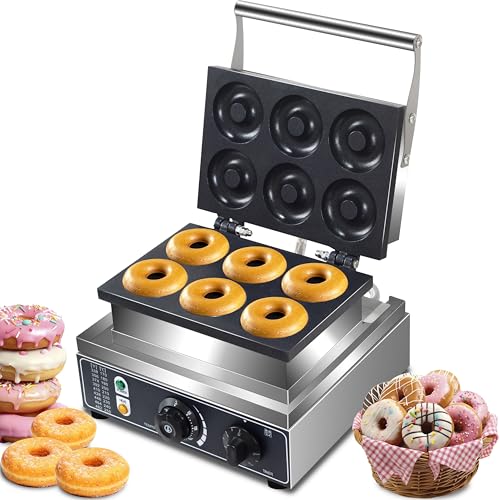
- 1600W double-sided heating for even baking
- Adjustable 50–300°C temperature and one-to-five-minute timer
- Compact stainless-steel design with non-stick plates
Best For: Small kitchens producing baked donut batches
Smallest-Footprint Pick

- Makes seven mini donuts per batch
- Compact, lightweight design for easy storage
- Fast-heating double-sided non-stick surface
Best For: Pop-ups, home-based sellers, and low-volume batches
Automatic Mid-Volume Pick
VEVOR 6-Row Automatic Donut Machine

- Produces approximately 360 donuts per hour
- Automated flipping and intelligent control panel
- 304 stainless steel with 4.5L hopper and 9.1L oil tank
Best For: Cafes, food stands, and moderate-volume donut production
Compact Home Batch Pick
Baker's Friend Mini Donut Maker

- Makes 12 mini doughnuts per batch
- Compact, lightweight countertop design
- PFOA-free nonstick surfaces simplify cleanup
Best For: Home-based sellers and small event batches
Adjustable Mid-Volume Option
YIYIBYUS 12-Grid Donut Machine

- Bakes 12 mini doughnuts in 1–5 minutes
- 1500-watt power with five settings
- Cool handle and nonstick pan aid operation
Best For: Cafes and vendors producing repeated small batches
High-Capacity Commercial Pick
FOHERE Automatic 4-Row Donut Maker

- Automatic four-row production system
- Output rated up to 250 mini doughnuts per hour
- 304 stainless steel with temperature and safety controls
Best For: Busy cafes, bakeries, and dessert shops
High-Capacity Pick

- Makes 23 mini doughnuts per batch
- Fast heating with no flipping required
- Compact non-stick design for easy cleanup
Best For: Cafés, bake sales, and light commercial use
Commercial-Style Control
15-Piece Electric Doughnut Baker

- Makes 15 doughnuts every 3–5 minutes
- Adjustable heat and 0–5 minute timer
- Stainless-steel body with removable crumb tray
Best For: Restaurants and dessert shops needing repeatable settings
Accessory-Friendly Option
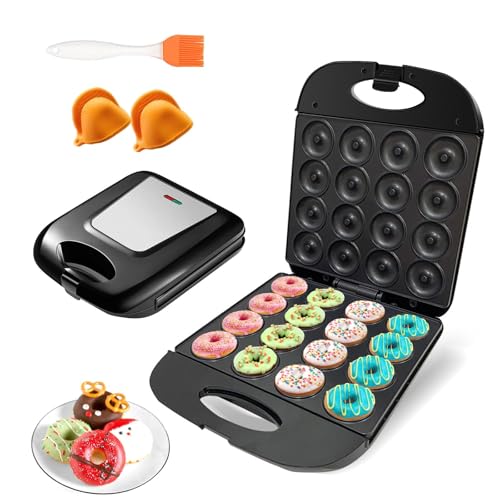
- Bakes 16 mini doughnuts in 1–5 minutes
- Double-sided heating for even cooking
- Includes mitts, oil brush, and user guide
Best For: Home-based sellers and small events
High-Output Pick – Kolice 6-Row Automatic Donut Machine
For doughnut makers for small businesses that need automated frying and high throughput, this Kolice machine combines forming, frying, flipping, collecting, counting, and outputting in one stainless-steel unit. Its stated capacity reaches up to 2,600 donuts per hour, though its large footprint and oil requirements make it better suited to established commercial workspaces.
Best For: Cafes, bakeries, dessert shops, buffets, and other businesses needing high-volume mini-donut production.
Pros:
- Automates forming, frying, flipping, collecting, counting, and outputting.
- Six rows and five thickness settings support faster production and size adjustment.
- 304 stainless-steel construction is corrosion-resistant and designed for easier cleaning.
- Includes a 17L oil tank, 9L hopper, tray, clip, molds, and spare fuses.
Cons:
- Its 31.5-by-23.62-by-15-inch size requires substantial counter or equipment space.
- The temperature display defaults to Celsius and cannot exceed 250°C.
- It must not be operated without oil or water in the tank.
This is the strongest option here for businesses prioritizing automated, high-volume mini-donut output. Confirm available space, electrical compatibility, and staff familiarity with Celsius controls before buying.
Compact Commercial Pick – 6-Hole Commercial Donut Waffle Maker
For doughnut makers for small businesses seeking a compact electric baker, this six-hole model offers double-sided heating, adjustable temperature, and timer controls in a relatively small stainless-steel body. It bakes rather than automatically fries, making it a practical fit for cafes, snack shops, and bakeries with limited space.
Best For: Small commercial kitchens that want consistent baked donuts and straightforward countertop operation.
Pros:
- 1600W dual-sided heating is designed for faster, more even baking.
- Temperature adjusts from 50°C to 300°C, with a one-to-five-minute timer.
- Non-stick plates support easier release and cleanup.
- Compact 33-by-32-by-23.5 cm design and 6.8 kg build provide a stable countertop setup.
Cons:
- Six-hole capacity is considerably lower than an automated multi-row fryer.
- It is intended for baked donut production, not automatic frying.
- The supplied notes do not specify an hourly production rate.
This model balances commercial-oriented controls with a space-saving footprint. It is a sensible choice when your menu calls for baked donuts and your priority is repeatable batches rather than maximum fryer throughput.
Smallest-Footprint Pick – Dash Express Mini Donut Maker
Among doughnut makers for small businesses, the Dash Express is the easiest to accommodate when counter space and storage are tight. It makes seven mini donuts at a time with a fast-heating, double-sided non-stick surface, but its single setting and home-oriented design make it better for low-volume service, samples, or occasional batches.
Best For: Small kitchens, pop-ups, home-based sellers, and businesses needing limited quantities of mini donuts.
Pros:
- Compact 8.7-by-10.6-by-3.9-inch footprint fits easily on a countertop.
- Lightweight 3.3-pound design is simple to store and move.
- Seven-donut capacity and fast heating support quick small batches.
- Double-sided non-stick plates help with release and cleanup.
Cons:
- Its seven-donut batch size is limited for sustained commercial demand.
- It has one setting and no listed adjustable temperature or timer controls.
- The product is positioned for home kitchens and dorm rooms rather than heavy-duty commercial use.
This is the most accessible option for testing a small donut offering or producing occasional batches. Businesses expecting steady customer volume will likely need a larger commercial baker or automated fryer.
Automatic Mid-Volume Pick – VEVOR 6-Row Automatic Donut Machine
For doughnut makers for small businesses that want automatic frying without the footprint of the largest machine here, the VEVOR ZDT-6 provides six-row production, automated flipping, and an intelligent control panel. It produces approximately 360 donuts per hour and forms classic ring donuts around 50 mm wide and 25 mm thick.
Best For: Cafes, bakeries, food stands, and other businesses needing automated mid-volume ring-donut production.
Pros:
- Six rows and automated flipping help improve production consistency.
- Approximately 360 donuts per hour suits moderate commercial demand.
- 304 stainless-steel construction is designed for easier cleaning and maintenance.
- Includes a 4.5L hopper and 9.1L oil tank to reduce frequent refilling.
Cons:
- The listed output is much lower than the 2,600-piece-per-hour Kolice model.
- It produces a specified ring size, offering less stated size flexibility.
- At 41.2 pounds and 22-by-19.5-by-15 inches, it still needs dedicated equipment space.
This machine offers a useful middle ground between countertop donut bakers and higher-output automated equipment. It is worth considering when consistent fried ring donuts matter, but projected demand does not justify the largest production capacity.
Compact Home Batch Pick – Baker's Friend Mini Donut Maker
For small businesses testing a doughnut menu from a home kitchen, the Baker’s Friend Mini Donut Maker offers a compact way to produce 12 bite-sized doughnuts per batch. Its simple operation and nonstick surfaces suit occasional sales, events, and made-to-order snacks.
Best For: Home-based sellers, pop-up events, and small batches of decorated mini doughnuts.
Pros:
- Bakes 12 mini doughnuts in a matter of minutes.
- Compact 12 x 11 x 2.75-inch design takes up little counter space.
- Two PFOA-free nonstick surfaces support even cooking and easier cleanup.
- Works with cake mix, brownie mix, and other batters.
Cons:
- Its 12-doughnut capacity is better suited to small batches than high-volume production.
- The notes do not specify a commercial-duty construction or adjustable temperature control.
This is a practical entry point for a small business that values portability and simplicity over throughput. Expect to work in repeated batches if demand grows.
Adjustable Mid-Volume Option – YIYIBYUS 12-Grid Donut Machine
Among doughnut makers for small businesses, the YIYIBYUS 12-Grid model is a stronger fit when faster batch turnover matters. Its 1500-watt heating system can bake 12 mini doughnuts in about 1–5 minutes, while five settings and adjustable firepower provide more process control.
Best For: Cafes, home businesses, and party or holiday vendors needing repeated 12-doughnut batches.
Pros:
- 1500 watts and a stated 1–5-minute baking time support quick production.
- Produces 12 mini doughnuts per batch.
- Five settings and adjustable firepower help control cooking.
- Nonstick pan and cool handle support easier handling and cleanup.
Cons:
- At 20 pounds and 14 x 11 x 9 inches, it is less portable than compact home models.
- The supplied details do not provide an hourly production rate or automatic forming and flipping.
The YIYIBYUS balances speed, capacity, and manual control for a small operation. It makes sense when a countertop machine needs to serve more than occasional batches without moving to a fully automatic fryer.
High-Capacity Commercial Pick – FOHERE Automatic 4-Row Donut Maker
For established doughnut makers for small businesses, the FOHERE Commercial Automatic Donut Maker is designed for substantially higher throughput. Its 4-row system combines forming, frying, flipping, collecting, counting, and outputting, with a stated capacity of up to 250 mini doughnuts per hour.
Best For: Bakeries, cafes, dessert shops, buffets, and other businesses with steady mini-doughnut demand.
Pros:
- Automatic workflow reduces manual forming, frying, flipping, and collecting.
- Four rows and a 3L hopper support output of up to 250 mini doughnuts per hour.
- 304 food-grade stainless steel construction is designed for professional kitchen use.
- Includes constant temperature control, adjustable frying speed, counting, and overheating protection.
Cons:
- Its 21.85 x 14.76 x 14.57-inch footprint and roughly 35-pound weight require dedicated space.
- The machine must not be operated without oil in the tank.
- Its commercial automation is likely excessive for occasional or very low-volume sellers.
The FOHERE is the clearest choice when labor savings and consistent volume matter more than portability. Its safety features, automatic counting, and stainless-steel construction make it better suited to a dedicated production area than a casual home setup.
High-Capacity Pick – 23-Hole Mini Donut Maker
For small businesses comparing doughnut makers for small businesses, this compact 23-hole model prioritizes batch size and straightforward operation. It cooks up to 23 mini doughnuts at once, heats quickly, and uses non-stick plates for easier release and cleanup.
Best For: Cafés, bake sales, school events, and small operations needing a lightweight, high-capacity mini doughnut maker.
Pros:
- Makes up to 23 mini doughnuts per batch.
- Fast, even heating requires no flipping or rotating.
- Non-stick plates support easy release and cleanup.
- Compact 10-by-10-inch footprint and one-touch operation.
Cons:
- At 110 watts, it may be less suited to demanding commercial throughput.
- Mini doughnut capacity is designed for small portions rather than full-size doughnuts.
This is a practical choice when counter space and batch capacity matter more than advanced controls. Its simple design suits occasional or light commercial service, while the 23-hole plate can help reduce repeated batches.
Commercial-Style Control – 15-Piece Electric Doughnut Baker
For operators who want more control from doughnut makers for small businesses, this stainless-steel model combines a 15-doughnut output with adjustable temperature and timer settings. Its 1,750-watt heating system and double-sided cooking are suited to repeated small batches.
Best For: Restaurants, dessert shops, schools, and small businesses that need adjustable cooking controls and a sturdier countertop build.
Pros:
- Produces 15 doughnuts every 3–5 minutes.
- Adjustable temperature from 32°F to 572°F and timer from 0–5 minutes.
- 201 stainless-steel body and cast-aluminum furnace plate support durability and heat distribution.
- Removable middle tray helps catch batter, oil, and debris.
Cons:
- At 26.5 pounds, it is less portable than lightweight home-style models.
- Its roughly 13-by-15-inch footprint requires more counter space.
- PTFE-coated plates require appropriate care to preserve the non-stick surface.
This model is the strongest fit for businesses that value repeatable settings and a more substantial build. Its smaller batch count than some compact makers is balanced by higher wattage, temperature control, and easier maintenance features.
Accessory-Friendly Option – 16-Hole Mini Doughnut Maker
Small operators seeking doughnut makers for small businesses may appreciate this 16-hole model for its quick baking cycle and included accessories. Double-sided heating, a non-stick surface, an oil brush, and mini oven mitts make it approachable for compact kitchens and occasional service.
Best For: Home-based sellers, small events, and businesses wanting a compact mini doughnut maker with basic accessories included.
Pros:
- Bakes 16 mini doughnuts in approximately 1–5 minutes.
- Double-sided heating supports even coloring and cooking.
- Includes an oil brush, mini oven mitts, and user guide.
- Compact design takes up relatively little counter space.
Cons:
- Its 16-doughnut capacity may require more batches for higher-volume orders.
- The supplied notes do not specify adjustable temperature controls.
- The listed dimensions are taller and deeper than some ultra-compact makers.
This is a convenient entry-level choice when accessories and simple operation are priorities. Its 1,400-watt output and quick stated baking time can support small orders, though higher-volume businesses may prefer a larger-capacity or more adjustable machine.
How We Picked the Best Doughnut Makers for Small Businesses
We assessed these machines by the factors that matter most in a small commercial setting: production capacity, cooking consistency, heat-up speed, machine footprint, controls, cleaning requirements, and likely operating cost. The selection includes both electric molded-doughnut makers and automatic frying machines because businesses have different menus, budgets, and service demands.
Capacity claims should be treated as maximum or approximate figures rather than guaranteed real-world output. Batch size, batter or dough preparation, staff workflow, recovery time, and finishing steps all affect how many doughnuts you can serve per hour.
Quick Comparison
| Machine type | Best for | Main advantage | Typical trade-off |
|---|---|---|---|
| Compact electric baker | Home businesses, cafés, and occasional service | Small footprint and simple operation | Lower batch capacity |
| Multi-hole commercial baker | Regular made-to-order production | Consistent shaped doughnuts with less oil | May require more manual loading and turning |
| Automatic fryer | Markets, kiosks, and high-volume sales | Higher throughput and reduced repetitive handling | More cleaning, ventilation, oil, and workspace needs |
Key Buying Factors for Doughnut Makers for Small Businesses
Capacity and Workflow
Choose capacity based on your busiest service period, not your average day. A small 6- to 16-cavity baker may suit made-to-order sales, while a four- or six-row automatic machine is better when customers expect a continuous supply. Leave enough time for loading, glazing, packaging, and refilling.
Power, Size, and Installation
Check voltage, wattage, plug type, counter depth, and clearance before ordering. High-wattage commercial models may need a dedicated circuit. Frying machines also require a safe location, suitable ventilation, oil storage, and heat-resistant surfaces.
Consistency and Controls
Adjustable temperature and timing controls help staff reproduce the same color and texture across batches. Non-stick plates simplify release, but they still need careful utensil use and routine inspection for coating wear.
Cleaning and Safety
Removable or accessible food-contact parts are valuable during busy service. Look for cool-touch handles, stable feet, overheat protection, and clear operating instructions. For fryers, consider oil draining, filtering, splash control, and daily cleaning time.
Who Should Buy Which Doughnut Makers for Small Businesses?
Choose a compact electric model if you are testing a doughnut menu, operating from a small kitchen, or selling modest quantities at breakfast and weekend events. A larger multi-cavity baker fits cafés and stalls that need dependable batches while keeping oil handling straightforward.
Choose an automatic commercial fryer when demand is consistently high and the business has the space, electrical supply, staff, and cleaning routine to support it. Before buying, compare the machine’s real output with your expected orders, then prioritize serviceability and workflow over the highest advertised capacity.