Making tomato sauce from fresh produce is easier when a press separates skins and seeds while you work. The best manual tomato presses can turn a large batch of tomatoes into smooth sauce with less peeling, coring, and mess.
We compared these 10 options by capacity, construction, adjustment, cleanup, and ease of use so you can choose the right tool for weeknight cooking, garden harvests, or serious canning.
Best 10 Manual Tomato Presses Picks for 2026
Most Versatile
Johnny Apple Sauce Maker Model 250

- 1.3mm apple/tomato screen
- Clamp fits 3/4–2-1/8-inch counters
- Handles sauces, purees, jams, and juices
Best For: Multi-purpose home food processing
High-Capacity Classic
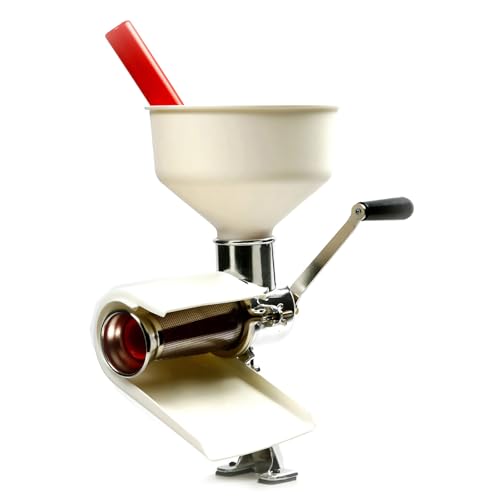
- 3-quart capacity
- Separates juice and pulp in one operation
- Includes fine screen and standard spiral
Best For: Larger home batches of sauces and purees
Simple Suction-Base Pick

- Suction-cup base
- Includes stainless steel pusher
- Separates skins and seeds while juicing
Best For: Fresh tomato juice, salsa, and puree
Best Compact Batch Press
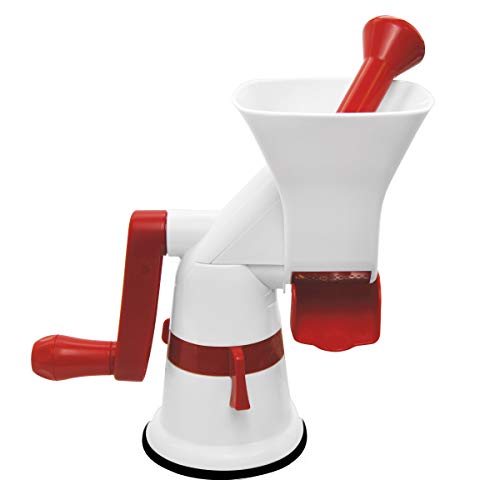
- 3-cup capacity for small batches
- 2mm stainless steel screen
- Auger helps prevent jamming and leaking
Best For: Occasional small-batch sauces, juices, and jams
Best Manual Tomato Press for Large Batches
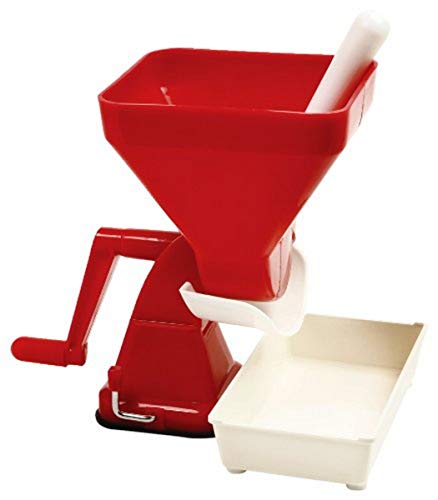
- 2.25-quart hopper for larger batches
- Stainless steel mesh separates skins and seeds
- Suction base helps stabilize cranking
Best For: Home canning and batch sauce preparation
Best Compact Italian Manual Tomato Press

- Designed for sauces and tomato purees
- Separates peels, pulp, and seeds
- Compact 5.91-inch listed dimensions
Best For: Occasional sauce making in smaller kitchens
Best High-Volume Tomato Strainer
Weston Deluxe Electric Sauce Maker

- One-gallon hopper for large batches
- 250-watt motor with reverse function
- Three stainless steel screens included
Best For: Fast, high-volume preserving and sauce making
Best Heavy-Duty Pick
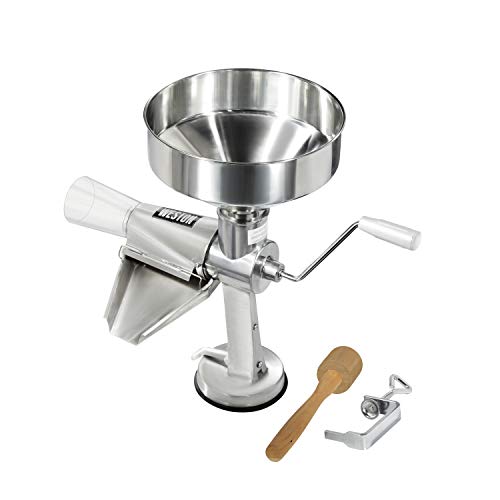
- One-gallon hopper for larger batches
- Dual suction-cup and C-clamp mounting
- Includes stomper and 1.5mm screen
Best For: Large-batch tomato sauce, puree, and salsa making
Best Accessory Bundle
Stainless Steel Food Mill With 3 Discs

- Three interchangeable milling trays
- Dual hooks stabilize bowls and pots
- Includes spoon, funnel, and measuring spoon
Best For: Multipurpose tomato sauce, jam, and meal preparation
Best Ergonomic Food Mill
Stainless Steel Mill With 3 Discs

- Three discs for adjustable textures
- Dual hooks fit deep or shallow cookware
- Dishwasher-safe stainless steel body
Best For: Canning, tomato sauce, purees, and everyday meal prep
Most Versatile – Johnny Apple Sauce Maker Model 250
For cooks seeking manual tomato presses that can handle more than one ingredient, the Johnny Apple Sauce Maker Model 250 is a flexible countertop option. Its hand crank separates skins and seeds through a 1.3mm apple/tomato screen, while the clamp fits countertops from 3/4 to 2-1/8 inches thick.
Best For: Home cooks making tomato sauce, purees, jams, baby food, and other fruit or vegetable preparations.
Pros:
- Includes an apple/tomato screen, standard spiral, and instruction manual.
- Can be used for sauces, juices, pie fillings, soups, and purees.
- Secure clamp provides a 10-square-inch clamping surface.
- Has a cast aluminum body, stainless steel screens, and BPA-free plastic components.
Cons:
- Optional electric motor and specialty screens cost extra.
- Requires a compatible countertop for clamp mounting.
This is a strong all-purpose pick if you want one manual strainer for tomatoes and a broad range of produce. The included fine screen is ready for sauce making, while optional accessories expand its uses.
High-Capacity Classic – Norpro 1951 Sauce Master
The Norpro 1951 Sauce Master is a practical choice among manual tomato presses when you want a larger stated capacity. It forces produce through a chrome-plated steel screen, separating juice and pulp in one operation.
Best For: Home cooks processing up to 3 quarts of vegetables, fruits, and purees for sauces, juices, and similar recipes.
Pros:
- Offers a 3-quart, or 95-ounce, capacity.
- Automatically separates juice and pulp while straining.
- Includes a standard fine mesh screen, standard spiral, recipes, and instructions.
- Additional berry, pumpkin, and salsa screens are available separately.
Cons:
- Additional screens are not included.
- Its listed dimensions are relatively substantial for a countertop appliance.
With its generous capacity and included fine screen, the Sauce Master suits batch-oriented cooks. Consider it when throughput matters more than having a compact manual press.
Simple Suction-Base Pick – Tomato Strainer 9911
This tomato strainer is a straightforward option for shoppers comparing manual tomato presses for fresh sauce and salsa. It uses a suction mount for stability, a stainless steel pusher, and a design that sends skins and seeds to the side while juice flows down the tray.
Best For: Gardeners and home cooks who want to strain, juice, or puree tomatoes without peeling, deseeding, or coring first.
Pros:
- Skins and seeds are ejected separately from the juice.
- Suction-cup base helps hold the strainer in place.
- Includes a stainless steel pusher.
- Suitable for tomato juice, homemade salsa, and purees.
Cons:
- Made primarily from plastic.
- Its suction mounting may depend on a suitable smooth surface.
This model focuses on uncomplicated tomato preparation rather than broad accessory compatibility. It is a sensible fit for fresh seasonal tomatoes and cooks who value a pusher and suction base.
Best Compact Batch Press – Weston Fruit & Tomato Press
The Weston Fruit & Tomato Press is one of the more compact manual tomato presses for small amounts of sauce, juice, or jam. Its 3-cup capacity, manual winding handle, stainless steel screen, and included stomper are designed for convenient small-batch processing.
Best For: Cooks making small batches of tomato sauces, juices, jams, baby food, or minced ingredients.
Pros:
- Compact 3-cup capacity suits smaller preparations.
- Stainless steel screen has 2mm holes.
- Innovative auger is designed to help prevent jamming and leaking.
- Includes a stomper and separates seeds and skins from pulp.
Cons:
- Limited to 3-cup batches.
- Its 2mm screen may provide a different texture than finer-screen presses.
If you rarely process large harvests, this Weston press keeps the scale manageable. Its compact capacity and anti-jamming auger make it particularly suitable for occasional, small-batch kitchen use.
Best Manual Tomato Press for Large Batches – Norpro Jumbo Tomato Strainer
If you want a manual tomato press for sauces, purees, or canning prep, the Norpro Jumbo Tomato Strainer is built for processing sizable batches without electricity. Its stainless steel mesh separates seeds, skins, and stems while the suction base helps keep the unit stable during cranking.
Best For: Home cooks processing garden tomatoes or cooked apples into smooth sauces and applesauce.
Pros:
- 2.25-quart hopper supports larger batches.
- Stainless steel mesh automatically separates seeds, skins, and stems.
- Suction base helps secure the press to smooth counters and tables.
- Includes a receiving tray, pestle, instructions, and starter recipes.
Cons:
- Requires manual cranking, which may be less convenient for very large harvests.
- The suction base is designed for smooth surfaces.
With its generous hopper and fitted receiving tray, this Norpro is a practical choice when you want manual control but still need useful batch capacity. It also handles cooked apples, adding versatility beyond tomato processing.
Best Compact Italian Manual Tomato Press – HOME Pachino Tomato Squeezer
The HOME Pachino is a straightforward manual tomato press for making sauces and tomato purees in a compact kitchen setup. Made in Italy, it separates tomato peels from pulp and seeds and uses a stainless steel handle with a plastic-coated grip.
Best For: Cooks seeking a simple, compact press for occasional tomato sauce and puree preparation.
Pros:
- Designed for sauces and tomato purees.
- Separates peels from tomato pulp and seeds.
- Stainless steel handle with a plastic-coated grip.
- Made in Italy.
Cons:
- The supplied notes do not specify hopper or receiving-container capacity.
- Its listed dimensions suggest a smaller format than large-batch presses.
This model suits shoppers who prioritize a basic, space-conscious tool over high-volume features. If you regularly process large harvests, confirm the working capacity before choosing it.
Best High-Volume Tomato Strainer – Weston Deluxe Electric Sauce Maker
Although it is electric rather than manual, the Weston Deluxe is worth considering when manual tomato presses are not fast enough for your workload. Its 250-watt motor, one-gallon hopper, reverse function, and three stainless steel screens are designed for sauces, purees, jellies, salsa, and preserving.
Best For: High-volume processing of tomatoes and other soft produce when speed matters more than manual operation.
Pros:
- One-gallon hopper is suited to large batches.
- 250-watt motor offers forward and reverse speeds.
- Includes 1.5mm, 3mm, and 6mm stainless steel screens.
- Stomper helps move food safely into the hopper.
Cons:
- It requires a 120-volt AC power source, unlike a manual press.
- Its electric motor may be unnecessary for small batches.
The Weston is a strong alternative for preserving large quantities, especially when interchangeable screens and reverse operation are useful. Choose it instead of a manual tomato press only if access to electricity and faster processing are priorities.
Best Heavy-Duty Pick – Weston Metal Tomato Strainer
For shoppers comparing manual tomato presses, the Weston Metal Tomato Strainer stands out for batch processing. Its one-gallon stainless steel hopper, smooth-turning handle, and included 1.5mm screen are designed for making tomato sauce, purees, salsa, jams, and preserves without peeling or coring first.
Best For: Large-batch tomato processing and cooks who want a countertop or garden-table mounting option.
Pros:
- Large one-gallon hopper supports bigger batches.
- Dual suction-cup and C-clamp mounting system offers flexible setup.
- Stainless steel splash guard and chute help direct puree neatly.
- Includes a stomper and 1.5mm multipurpose screen.
Cons:
- Additional screens require a separately sold accessory kit.
- Its mounting system is best suited to flat surfaces.
The Weston is the most purpose-built option here for sauce-making volume. Choose it if secure mounting and a large hopper matter more than the versatility of a bowl-style food mill.
Best Accessory Bundle – Stainless Steel Food Mill With 3 Discs
This stainless steel food mill is a versatile alternative for anyone shopping for manual tomato presses that can handle more than tomatoes. Three milling discs support fine, medium, and coarse results for tomato sauce, mashed potatoes, jams, fruits, and vegetables, while the dual hooks help stabilize it over a bowl or pot.
Best For: Home cooks who want one manual mill for tomato sauce, mashed foods, jams, and general meal preparation.
Pros:
- Includes three milling trays with different pore sizes.
- Dual-hook design helps hold the mill securely on bowls and pots.
- Food-grade stainless steel construction is dishwasher-safe.
- Includes a multifunctional spoon, wide-mouth funnel, and measuring spoon.
Cons:
- It is a bowl- or pot-mounted mill rather than a dedicated clamp-on tomato strainer.
- The included accessories add versatility but may mean more parts to store.
With its three discs and helpful accessories, this model is a practical multipurpose choice. It makes sense when tomato processing is only one part of your kitchen routine.
Best Ergonomic Food Mill – Stainless Steel Mill With 3 Discs
For a straightforward manual tomato press alternative, this stainless steel food mill combines three grinding discs with an ergonomic dual-hook design. Its coarse, medium, and fine options can produce tomato sauce, purees, jams, applesauce, and mashed foods, while the silicone-covered crank is designed for a more comfortable grip.
Best For: Canning and everyday cooks who want adjustable textures and a mill that fits different pot or bowl depths.
Pros:
- Three interchangeable discs cover coarse, medium, and fine textures.
- Dual hooks help secure the mill over deep or shallow pots and bowls.
- Dishwasher-safe stainless steel is resistant to stains and corrosion.
- Upgraded larger blades are designed to improve grinding efficiency.
Cons:
- It does not provide the dedicated large hopper or clamp mounting of the Weston strainer.
- The listed dimensions may require checking available storage space.
This food mill is a solid choice when texture control and comfortable hand cranking are priorities. Its broad food-preparation range makes it useful beyond seasonal tomato processing.
How We Picked the Best Manual Tomato Presses
We focused on the features that matter during real sauce-making sessions: how efficiently each press separates pulp from skins and seeds, how securely it mounts or rests on a work surface, and how easy it is to feed, turn, adjust, and clean. We also considered construction materials, hopper size, output capacity, replacement-part practicality, and whether a model is better suited to occasional batches or heavy seasonal use.
The lineup includes clamp-based strainers, hand-crank tomato presses, food mills, and one electric option for shoppers comparing manual effort with faster processing. Because product names and configurations can vary, confirm the included screens, mounting hardware, and capacity before ordering.
Quick Comparison
| Best For | Look For | Why It Matters |
|---|---|---|
| Occasional sauce | Compact body and simple hand crank | Easy storage and straightforward setup |
| Garden harvests | Larger hopper and sturdy clamp | Fewer refills and better stability |
| Frequent canning | Metal components and replaceable parts | Improved durability over repeated batches |
| Multiple foods | Food mill with interchangeable discs | Useful for potatoes, jams, purées, and sauces |
Key Buying Factors for Manual Tomato Presses
Capacity and Batch Size
A small hopper works well for a few pounds of tomatoes, while a larger hopper saves time during harvest season. Consider both hopper capacity and how quickly pulp exits; a large hopper does not always mean higher overall throughput.
Construction and Stability
Stainless steel and reinforced metal components generally handle repeated use better than lightweight plastic. A strong clamp, broad base, or secure countertop grip is important because pressing and cranking can move an unstable machine.
Separation and Adjustability
Look for a screen designed to remove skins and seeds without wasting usable pulp. Adjustable pressure or interchangeable screens can help you produce thinner sauces, thicker purées, or other textures.
Cleaning and Storage
Removable parts simplify rinsing and reduce trapped pulp. Check whether components are dishwasher safe, but follow the manufacturer’s instructions for screens, seals, clamps, and any metal finish.
Manual Effort
Manual Tomato Presses are quiet and do not require an outlet, but they require steady cranking. A comfortable handle and smooth auger make a noticeable difference when processing several batches.
Who Should Buy Which Manual Tomato Presses?
Choose a compact clamp-style press if you make sauce occasionally and want affordable, easy storage. Choose a larger hand-crank strainer for garden harvests, family-size batches, or home canning. Choose a stainless-steel model if durability and frequent seasonal use are priorities. Choose a food mill if you want one tool for tomatoes, potatoes, jams, and vegetable purées. Finally, consider an electric strainer if reducing physical effort and processing time matters more than portability or silent operation.