Choosing the best commercial pasta machine means balancing throughput, dough consistency, cutter options, cleanup, and available kitchen space. The right model can reduce prep time while producing uniform sheets, noodles, or shaped pasta.
This roundup covers automatic electric machines, dough sheeters, dual-cutter models, and higher-capacity production equipment for restaurants, caterers, and demanding home kitchens.
Best 10 Commercial Pasta Machine Picks for 2026
Heavy-Duty Versatility
Electric Commercial Pasta Machine

- Automatic kneading, pressing, and cutting
- 3 mm and 9 mm dual noodle cutters
- Rated for 45–55 lb of noodles per hour
Best For: Small food businesses and high-volume home kitchens
Family-Batch Convenience
Philips 7000 Series Pasta Maker

- Makes up to eight portions per batch
- Eight discs for varied pasta shapes
- Automatic preparation in under 10 minutes
Best For: Families seeking quick, low-mess pasta making
Classic Italian Craft
Marcato Atlasmotor 110V Pasta Machine
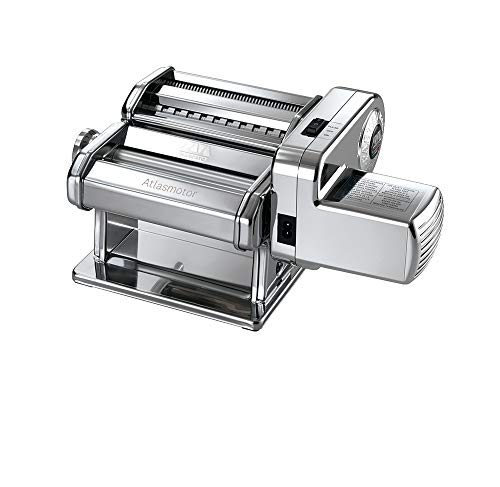
- Made and assembled in Italy
- 10 thickness positions for controlled sheets
- Includes handcrank, clamp, and electric motor
Best For: Small-batch cooks who want manual and electric control
High-Output Extrusion
Automatic Macaroni Pasta Maker

- 10–25 kg-per-hour stated capacity
- Includes fusilli, spaghetti, and penne molds
- Supports additional interchangeable dies
Best For: Restaurants and small food-processing operations
Heavy-Duty Dual-Function Pick
Newhai 750W Commercial Pasta Maker

- Presses dough and cuts noodles in one setup
- 0.12–18 mm adjustable sheet thickness
- Heavy 22 kg stainless-steel commercial build
Best For: Restaurants and serious home cooks needing versatile, heavy-duty prep
Simple Round-Noodle Option
Stainless Steel Electric Pasta Press Maker

- 550W copper motor for batch dough pressing
- Dedicated 3 mm round noodle cutter
- Adjustable 0.3–3 mm sheet thickness
Best For: Kitchens focused on automatic round noodles and wrappers
Dual-Width Prep Pick

- Built-in 2 mm and 6 mm noodle cutters
- 0.1–5 mm adjustable dough-sheet gap
- Rolls and cuts noodles, wrappers, and pasta
Best For: Larger-batch kitchens making varied dough products
Best Overall
750W Adjustable Commercial Pasta Machine

- 2-in-1 rolling and cutting operation
- 0.12–18mm adjustable thickness
- 3mm and 9mm noodle blades
Best For: Versatile home and small-business kitchen use
Best Compact Commercial Option
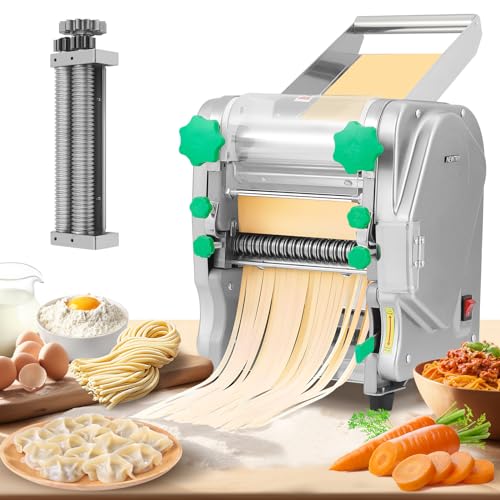
- 550W automatic operation
- 2mm/6mm and 2.5mm blades
- 0.1–18mm thickness adjustment
Best For: Smaller commercial batches and home kitchens
Best for High-Volume Use
YIMOHOME 750W Stainless Steel Pasta Maker

- Stated 45–66 lb/hour output
- 3-in-1 kneading, pressing, and cutting
- 304 stainless steel roller and cutter
Best For: Restaurants and higher-volume pasta production
Heavy-Duty Versatility – Electric Commercial Pasta Machine
This commercial pasta machine is designed for buyers who need one countertop appliance for noodles, dough sheets, and dumpling wrappers. Its automatic kneading, pressing, and cutting functions, stainless steel construction, and stated 45–55-pound hourly workload make it a practical option for a small restaurant, snack shop, or high-volume home kitchen.
Best For: Small noodle restaurants, dumpling shops, breakfast businesses, and households making large batches.
Pros:
- Combines kneading, pressing, and cutting in one automatic machine.
- Includes dual cutters for 3 mm and 9 mm noodles.
- Adjustable dough thickness from 0.1 to 5 mm.
- Stainless steel body and a stated 45–55 lb-per-hour workload.
Cons:
- At about 44–46 pounds, it is less convenient to move than a household pasta maker.
- Its 3 mm and 9 mm cutters offer fewer built-in noodle widths than some accessory-based machines.
- The notes describe a one-year warranty, so buyers should review coverage details.
Choose this model when throughput and multifunctionality matter more than portability. Its compact footprint helps with countertop placement, while the automatic operation is better suited to repeated production than occasional hand-cranked pasta making.
Family-Batch Convenience – Philips 7000 Series Pasta Maker
The Philips 7000 Series is a convenient automatic pasta maker for home cooks who want fresh pasta with minimal hands-on work. It can prepare up to eight portions in one batch, includes eight shaping discs, and uses dishwasher-safe, non-stick parts to simplify cleanup.
Best For: Families and hosts who want quick, automated homemade pasta rather than commercial-volume production.
Pros:
- Prepares fresh pasta in under 10 minutes, according to the supplied notes.
- Large capacity for up to eight portions.
- Eight discs provide multiple pasta-shape options.
- HomeID app offers step-by-step recipes, including vegan and gluten-free ideas.
Cons:
- Its 150W design and eight-portion capacity are intended for home use, not commercial throughput.
- The listed dough thickness range is 1 to 1.5 mm, offering less adjustment than some pasta machines.
- It is not presented as a roller-style machine for extra-wide sheets or dumpling wrappers.
For a household shopping for a commercial pasta machine alternative, this Philips model prioritizes speed, guided recipes, and easy maintenance. It is a stronger fit for convenient family meals than for continuous restaurant production.
Classic Italian Craft – Marcato Atlasmotor 110V Pasta Machine
The Marcato Atlasmotor 110V is a compact electric-assisted pasta roller for cooks who prefer direct control over sheet thickness. This commercial pasta machine candidate is made and assembled in Italy, includes both a handcrank and motor, and rolls sheets up to 6 inches wide with 10 thickness positions.
Best For: Home cooks, culinary enthusiasts, and small-batch operators who value Italian construction and manual control.
Pros:
- Includes the Atlas 150, handcrank, clamp, Pastadrive motor, and manual.
- Offers 10 clear thickness settings.
- Can be operated manually or electrically.
- Compatible with 11 separately available Marcato accessories.
Cons:
- Its 6-inch sheet width and 9.5-pound weight are better suited to small batches than heavy commercial production.
- The supplied details list manual operation, so it does not provide fully automatic mixing or extrusion.
- Additional pasta-shape accessories are sold separately.
This model makes sense when precision and flexibility are more important than maximum output. The included motor reduces repetitive cranking, but the roller format still requires more hands-on preparation than an automatic commercial extruder.
High-Output Extrusion – Automatic Macaroni Pasta Maker
This full-automatic commercial pasta machine is built for food businesses that need extruded shapes rather than rolled sheets. The stainless steel unit uses interchangeable dies to produce fusilli, spaghetti, and penne, with a stated capacity of 10–25 kg per hour for bakeries, restaurants, snack operations, and food-processing settings.
Best For: Restaurants, bakeries, snack businesses, and small food-processing plants producing multiple extruded pasta shapes.
Pros:
- Automatic 2.2 kW machine with a stated 10–25 kg-per-hour capacity.
- Includes three molds for fusilli, spaghetti, and penne.
- Additional dies can expand the range to shapes such as macaroni, rotini, and farfalle.
- Stainless steel construction and simple-cleaning design.
Cons:
- At 176 pounds and about 19.7 by 18.5 by 30.7 inches, it requires dedicated space and handling.
- Additional molds cost extra.
- The supplied specifications list a 110V, 2.2 kW power requirement, which should be checked against the installation site.
Among these options, this is the clearest production-focused choice for shaped pasta. It is considerably larger and heavier than countertop models, but its extrusion system and expandable die selection are better aligned with sustained commercial use.
Heavy-Duty Dual-Function Pick – Newhai 750W Commercial Pasta Maker
If you need a commercial pasta machine that can press dough and cut noodles in one workflow, the Newhai 750W model offers a substantial stainless-steel build and broad thickness adjustment. Its 22 kg frame, steel gears, and dual-belt transmission are suited to demanding kitchen prep, though its automatic cooling shutdown requires planning during long sessions.
Best For: Restaurants and serious home cooks needing a heavy-duty machine for sheets, wrappers, and noodles.
Pros:
- Presses dough and cuts pasta without removing the blades.
- Offers an unusually broad 0.12–18 mm thickness range.
- Uses a 750W motor, stainless-steel components, steel gears, and non-slip pads.
- Includes 2.5 mm round and 2 mm/6 mm cutting options.
Cons:
- At 22 kg, it is heavy and not especially portable.
- Automatically shuts down after 1–2 hours of continuous operation and needs 10–20 minutes to cool.
- Its semi-automatic operation still requires hands-on dough feeding.
The Newhai stands out when durability, versatility, and integrated pressing and cutting matter more than a compact footprint. Confirm that your workspace can accommodate its weight and cooling cycle before buying.
Simple Round-Noodle Option – Stainless Steel Electric Pasta Press Maker
This stainless steel commercial pasta machine is designed for straightforward noodle pressing with a 3 mm round cutter. Its 550W copper motor, adjustable thickness control, and easy-clean construction make it a practical choice for kitchens producing noodles, dumpling skins, wonton skins, or wide noodles.
Best For: Homes, restaurants, hotels, and food-processing settings that want automatic pressing with a round-noodle focus.
Pros:
- Stainless steel construction is durable, rust-resistant, and easy to clean.
- 550W pure copper motor is designed for high-gluten dough and batch production.
- Adjustable thickness control helps create more uniform sheets.
- Can make 3 mm round noodles, dumpling skins, wonton skins, and wide noodles.
Cons:
- Only one 3 mm round blade is specified.
- The listed thickness range is narrow at 0.3–3 mm.
- Its 19.69-inch height may require careful counter-space planning.
This model is best suited to buyers who value simple automatic operation and a dedicated round-noodle format. It is less flexible than machines with multiple integrated cutter widths or a wider sheet-thickness range.
Dual-Width Prep Pick – XINGYUEXUAN 550W Pasta Maker
The XINGYUEXUAN is a commercial pasta machine for cooks who want two built-in noodle widths without changing the cutter assembly. Its 550W motor and adjustable 0.1–5 mm roller gap support fresh noodles, dumpling wrappers, wontons, lasagna, and ravioli in a semi-automatic workflow.
Best For: Restaurants, noodle shops, food-prep businesses, and home users making varied dough products in larger batches.
Pros:
- Built-in 2 mm and 6 mm cutters provide two practical noodle widths.
- Adjustable 0.1–5 mm roller gap handles thin wrappers and thicker sheets.
- Combines dough rolling, forming, and cutting in one machine.
- Stainless steel body with a 550W, 110V motor suits repeated prep.
Cons:
- Semi-automatic operation still requires feeding and handling the dough.
- The 27-inch length creates a relatively large countertop footprint.
- Only a single cutter assembly is listed, despite its two cutting widths.
Choose the XINGYUEXUAN when recipe flexibility is a priority. Its dual-width cutter and broad sheet adjustment are useful for mixed production, while the elongated design may be better suited to a dedicated prep surface than a small kitchen counter.
Best Overall – 750W Adjustable Commercial Pasta Machine
This commercial pasta machine combines dough rolling and noodle cutting in one electric unit, making it a practical choice for kitchens that need flexible preparation without changing attachments. Its 750W motor, stainless steel construction, and broad 0.12–18mm thickness range support pasta, wrappers, and pastry sheets.
Best For: Home cooks, cafés, snack bars, and small catering operations that want one machine for rolling and cutting.
Pros:
- Switches between dough pressing and noodle cutting without disassembling parts.
- Adjusts from ultra-thin 0.12mm sheets to 18mm thickness.
- Includes dual-use cutting for 3mm spaghetti and 9mm fettuccine.
- Steel gears, double-belt transmission, and a bottom baffle are designed for stable, lower-noise operation.
Cons:
- The included cutting options are limited to 3mm and 9mm widths.
- The notes cite a 20–30kg-per-hour dough-processing capacity, which may be modest for higher-volume businesses.
Choose this model if you value versatility and fine thickness control in a compact stainless steel commercial pasta machine. It is especially appealing for mixed kitchen use rather than highly specialized, large-scale production.
Best Compact Commercial Option – NEWTRY Electric Dough Roller
The NEWTRY electric dough roller is a substantial 45-pound commercial pasta machine with a 20cm dough width and adjustable 0.1–18mm thickness. Its handle-based mode change makes it straightforward to move between pressing dough and cutting pasta.
Best For: Users who want a sturdy, relatively quiet machine with multiple included blade configurations for household or commercial use.
Pros:
- Offers 2mm/6mm fettuccine cutting plus a 2.5mm round pasta blade.
- Supports dough thicknesses from 0.1mm to 18mm.
- Changes between pressing and cutting by moving the handle, without removing the blade.
- Nylon gears and updated guards are intended to reduce noise and help protect the motor.
Cons:
- Its 550W motor is less powerful than the 750W motors in the other listed models.
- The 7.8-inch/20cm dough width may be limiting for wider production batches.
- At about 42–45 pounds, it is not especially portable.
This NEWTRY model makes sense when ease of operation and blade variety matter more than maximum motor power. Its 20cm working width and automatic operation suit smaller batches, while the heavy build favors a dedicated countertop location.
Best for High-Volume Use – YIMOHOME 750W Stainless Steel Pasta Maker
The YIMOHOME is a heavy-duty commercial pasta machine built around a 750W all-copper motor, cast-iron gears, and stainless steel rollers and cutters. Its stated 45–66 pounds-per-hour output and 3-in-1 kneading, pressing, and cutting design make it geared toward restaurants and other demanding kitchens.
Best For: Restaurants and businesses that need higher stated throughput and a broader range of pasta and dough applications.
Pros:
- Combines kneading, pressing, and cutting in one automatic machine.
- States a workload of 45–66 pounds of fresh noodles per hour.
- Uses 304 stainless steel for the cutter and roller, plus a 750W all-copper motor.
- Supports 3mm and 9mm noodles, with additional cutter sizes available for selection.
Cons:
- Its approximately 46-pound, 13-inch-by-12-inch-by-14-inch form is heavy for frequent repositioning.
- The supplied details contain inconsistent thickness specifications, so buyers should verify the actual adjustment range before purchase.
- Additional cutter sizes are described as available for selection, but the included configuration should be confirmed.
Among these options, the YIMOHOME has the strongest stated production capacity and the most business-oriented feature set. It is a good fit for buyers prioritizing throughput and construction, provided they confirm the thickness and cutter details that apply to their chosen configuration.
How We Picked the Best Commercial Pasta Machines
We focused on the features that matter most in real kitchens: motor power, construction, roller adjustment, cutter formats, operating capacity, versatility, and ease of cleaning. The selection includes compact electric units for smaller operations as well as heavier commercial machines designed for more consistent, higher-volume production.
We also considered whether each machine is better suited to rolling sheets, cutting noodles, pressing dough, or handling a broader range of pasta styles. Product specifications can vary by configuration, so confirm voltage, included accessories, dimensions, and replacement-cutter availability before ordering.
Quick Comparison
| Best For | What to Look For |
|---|---|
| Small restaurants and caterers | 750W-class motor, stainless-steel body, adjustable rollers, and simple controls |
| High-volume production | Automatic feeding or extrusion, stronger continuous-duty construction, and serviceable parts |
| Restaurants needing varied cuts | Multiple cutters, interchangeable dies, or included accessories |
| Serious home cooks | Compact footprint, manageable cleanup, lower noise, and straightforward operation |
Key Buying Factors for a Commercial Pasta Machine
Motor Power and Workload
Wattage is a useful starting point, but it does not tell the whole story. A machine used intermittently can need less power than one running through a busy service. For frequent batches, prioritize a robust motor, cooling design, stable gearing, and a manufacturer that supports replacement parts.
Roller Range and Cutter Options
Adjustable thickness is essential for lasagna sheets, ravioli, and different noodle styles. Check the actual thickness range rather than relying on a broad marketing label. Common cutter widths include narrow spaghetti-style cuts and wider fettuccine-style cuts; extra dies or rollers can add useful flexibility.
Materials, Cleaning, and Safety
Stainless steel is usually preferable in a commercial kitchen because it resists corrosion and is easier to sanitize. Look for removable accessories, accessible dough-contact surfaces, non-slip feet, guards around moving parts, and controls that can be operated safely during busy prep.
Capacity and Installation
Measure counter depth, clearance, and storage space before buying. Also verify the electrical requirements, especially for 110V or commercial-voltage models. A larger machine may improve throughput but can be impractical if it cannot be positioned, cleaned, or stored conveniently.
Who Should Buy Which Commercial Pasta Machine?
Choose a compact electric cutter or sheeter if you run a small kitchen, make pasta to order, or need an accessible backup machine. A dual-cutter model is useful when you want two common noodle widths without changing equipment.
For restaurants and catering operations producing several batches per day, look for a 750W-class commercial unit with adjustable thickness, sturdy stainless construction, and readily available replacement parts. If your operation requires continuous output or a specific extruded shape, a dedicated automatic macaroni or spaghetti production machine may be a better investment than a general-purpose roller.
Home cooks who want convenience should favor simpler machines with clear controls and included accessories, while businesses should prioritize throughput, serviceability, warranty coverage, and total operating cost over the lowest purchase price.